Attic Office Lighting: 9 Ideas for Windowless Attics
A windowless attic is the hardest room in the house to light for work. There is no daylight to borrow, the ceiling slopes down over your desk, and the far corners go dark by mid-afternoon even when the rest of the house is bright. A single ceiling bulb makes it worse: it throws hard shadows, glares on your screen, and leaves you squinting by 4 p.m.
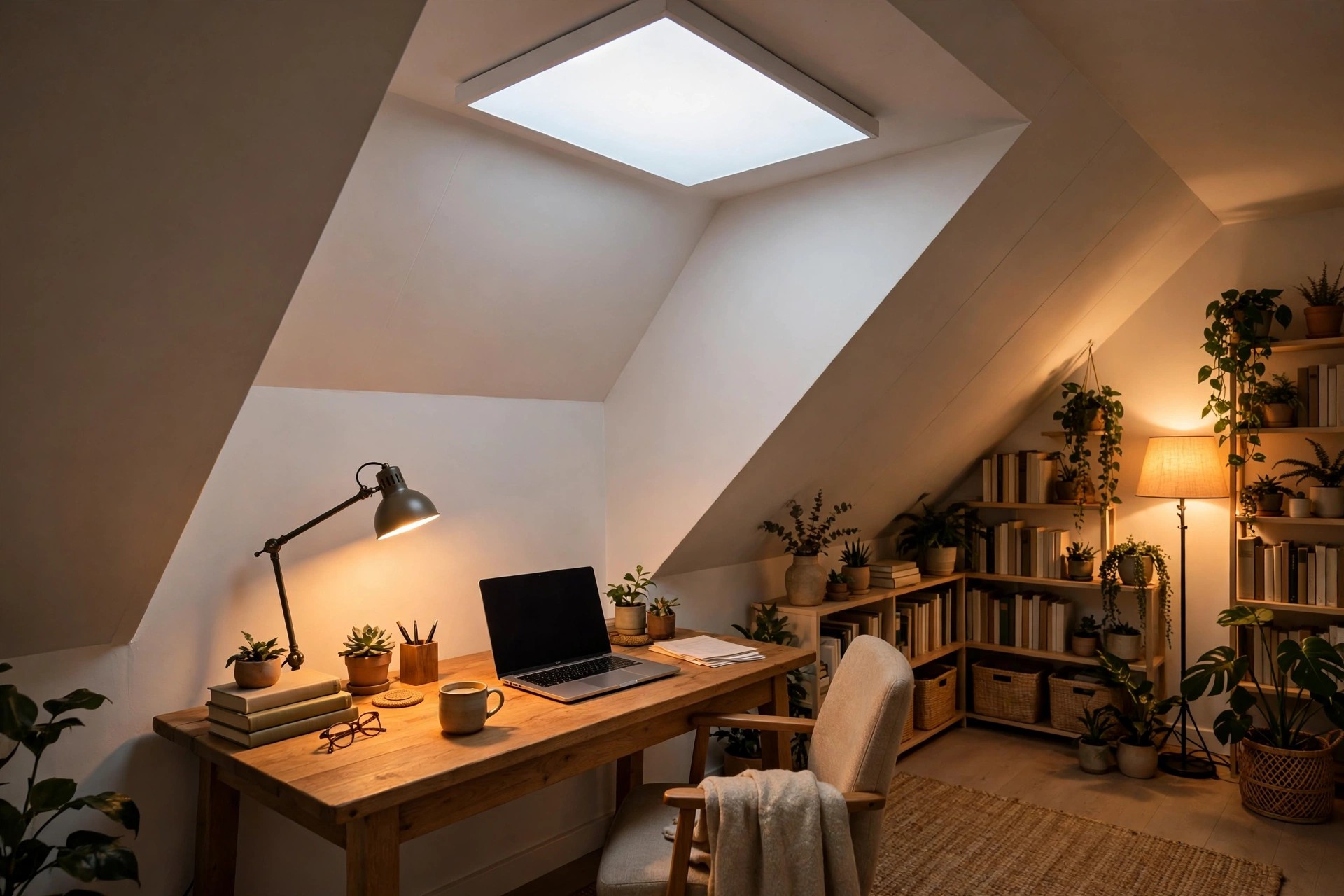
The fix is layers — several smaller light sources doing different jobs, installed in the right order. Get the order right and even a fully windowless attic can feel like a normal, comfortable office. Get it wrong and you end up buying lamps one at a time and wondering why the room still feels like a cave.
The order of work
Work in this sequence, and stop when the room feels right.
- Ceiling light first. One even wash of ambient light across the whole room. This is your base layer; everything else sits on top of it.
- Task light at the desk. A focused light on your keyboard, papers, and hands — the place your eyes actually work.
- Fill the dark corners. One light aimed at the wall or corner opposite your desk, so the room has no black holes in your peripheral vision.
- Tune the colour. Cooler light while you work, warmer in the evening — the cheapest step here, and the one that changes how the room feels most.
1. Start with a flush-mount LED panel overhead
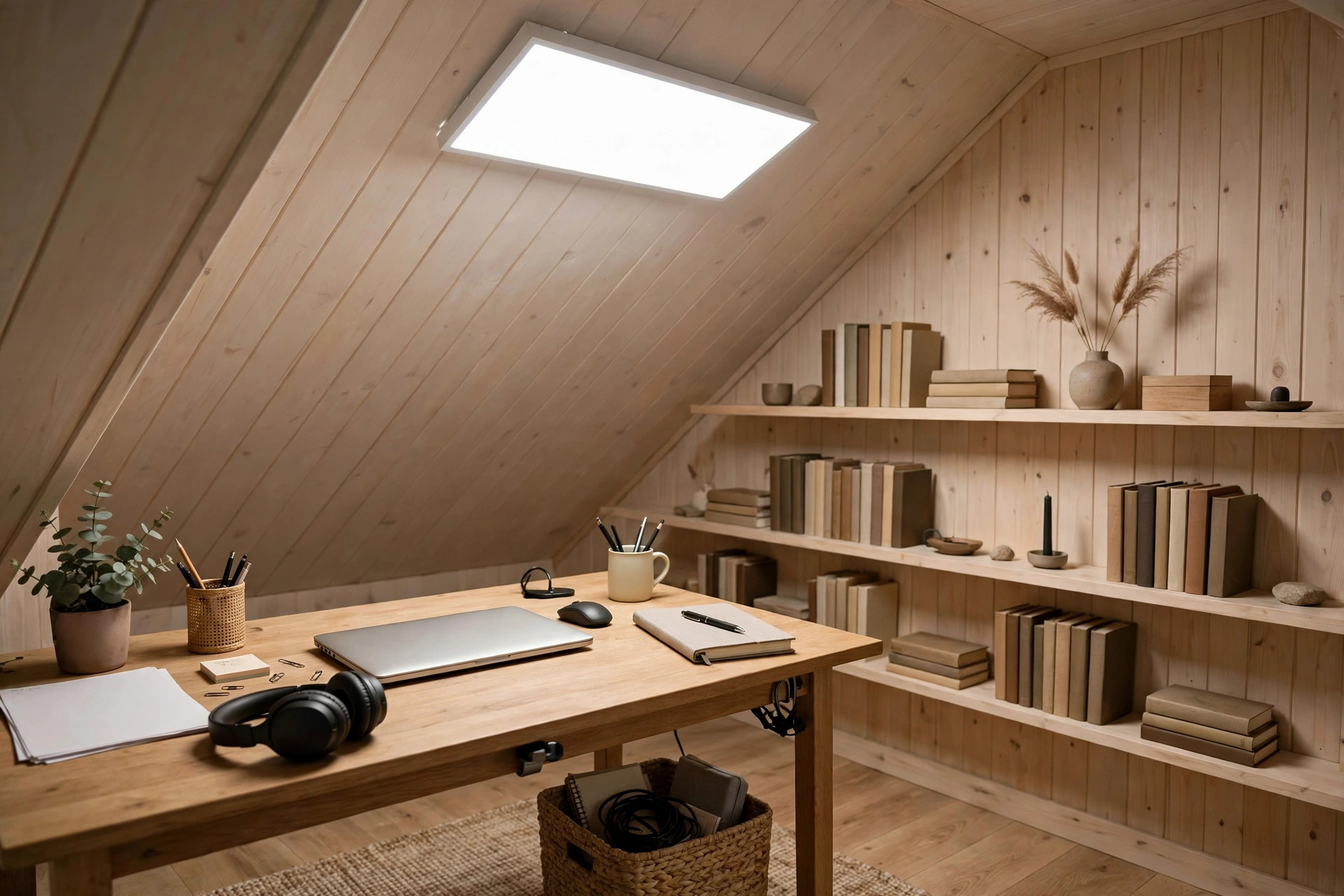
Attics rarely have the ceiling height for a hanging pendant, and a pendant swings light into the slope anyway. A slim flush-mount fixture or flat LED panel sits tight to the ceiling and spreads light evenly, instead of in one pool. Centre it in the room, not over your chair (screen glare) or over the desk (your head blocks it).
Look for a panel with a diffuser (a frosted cover, not bare diodes) and a dimmer, or one with selectable colour temperature. Typical range: about $25–$60 for a decent panel. If your attic already has a single bulb socket in the ceiling, this is a straight swap.
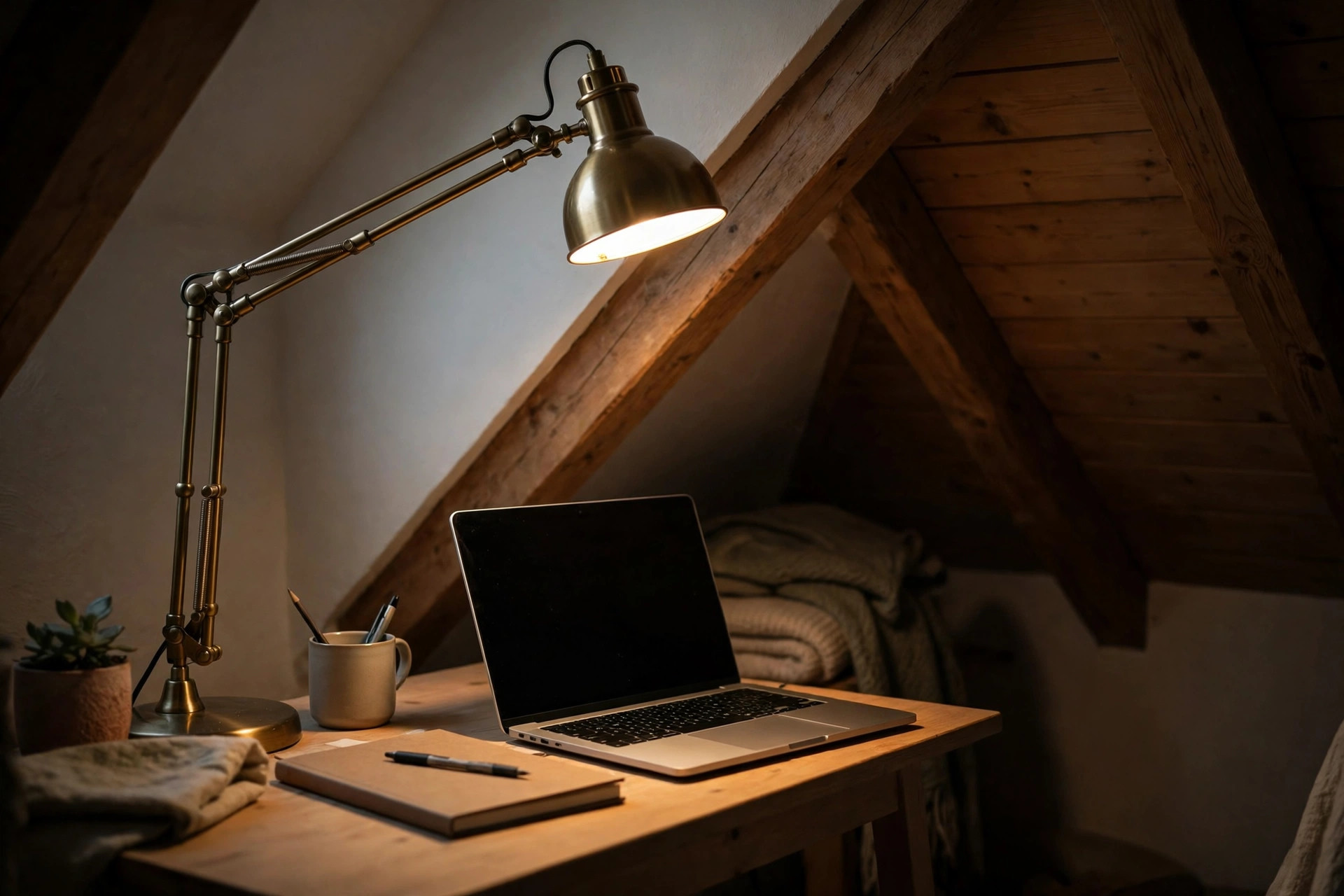
2. Add an adjustable desk lamp
If you buy only one thing from this list, buy this. A good desk lamp with adjustable brightness and colour temperature does more than any ceiling fixture, because it lights exactly where your eyes work.
Put it opposite your writing hand — left if you are right-handed — so your hand throws no shadow across the page. Angle it at the desk, not at your face or the screen. A lamp with a warm-to-daylight range (roughly 2700K to 5000K) covers both focus work and evening wind-down. Typical range: about $30–$80 for an adjustable LED desk lamp.
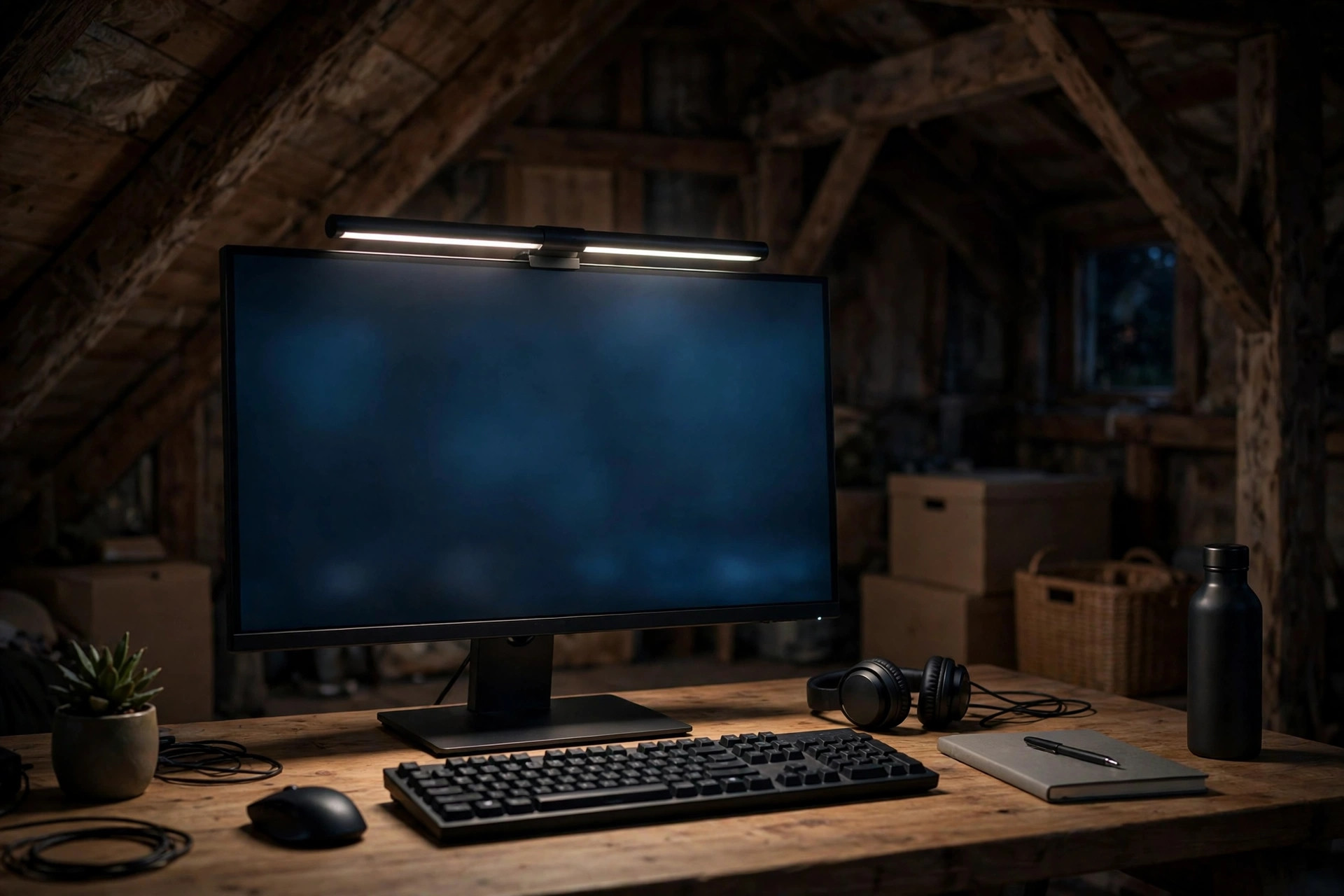
3. Put a monitor light bar on top of your screen
A monitor light bar clips to the top of your screen and washes light down across the desk without lighting the screen. In a windowless attic it solves a specific problem: the contrast between a bright screen and a dark desk, which is what makes your eyes tired.
It takes no desk or floor space — nothing to knock over under a slope. Typical range: about $40–$100. If your budget only stretches to one task light, choose between this and a desk lamp: the lamp wins if you read paper or write by hand; the light bar wins if you work almost entirely on screen.
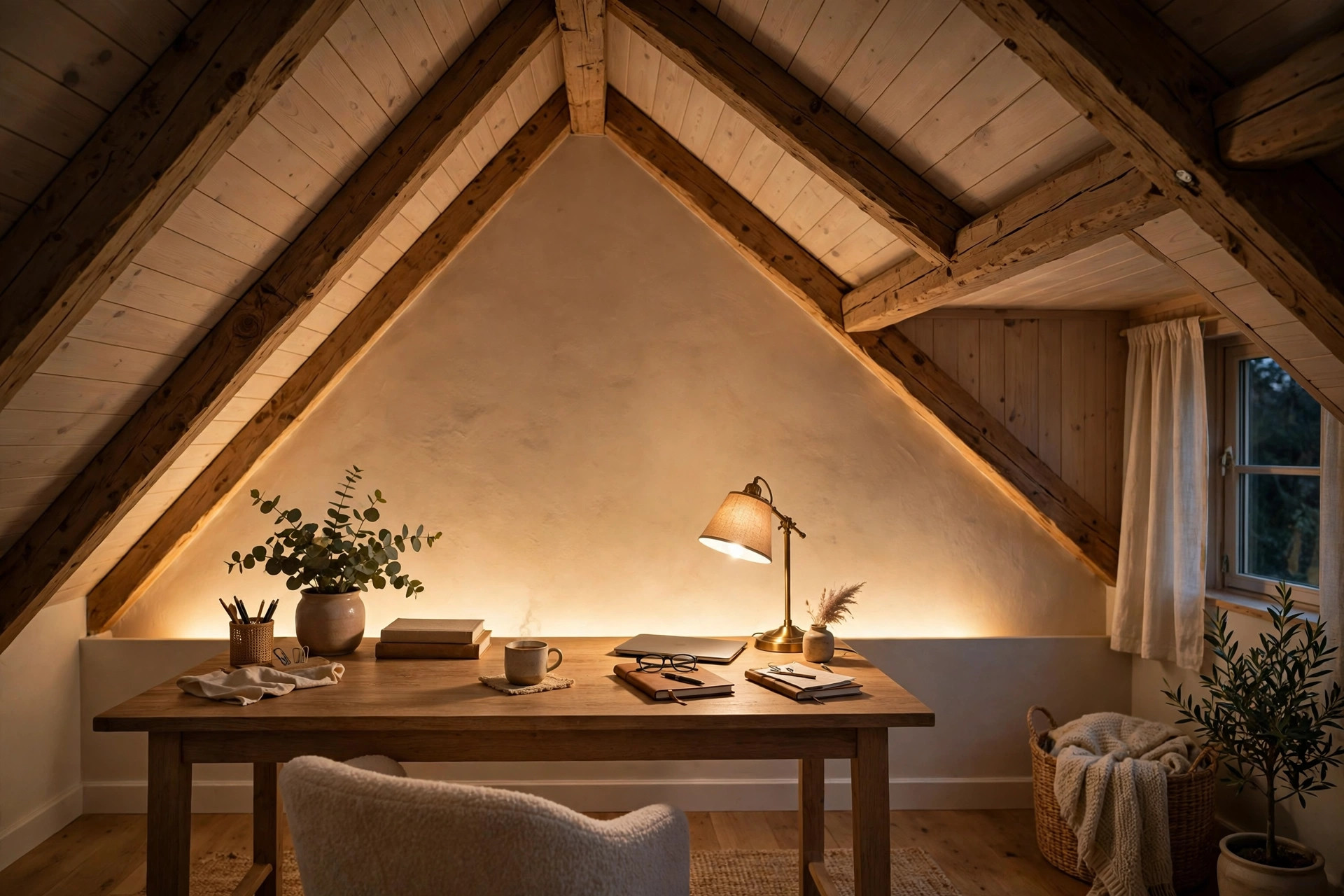
4. Wash the wall behind your desk
Your eyes judge brightness by the wall behind your screen, not by the screen itself. When that wall is dark, the screen feels blinding even at low brightness. A bias light behind the monitor, or a short LED strip on a shelf behind the desk, lifts the wall to a soft glow and the eye strain drops.
Keep it warm and dim — a gentle halo, not a second desk lamp. A basic bias-light strip costs about $15–$30.
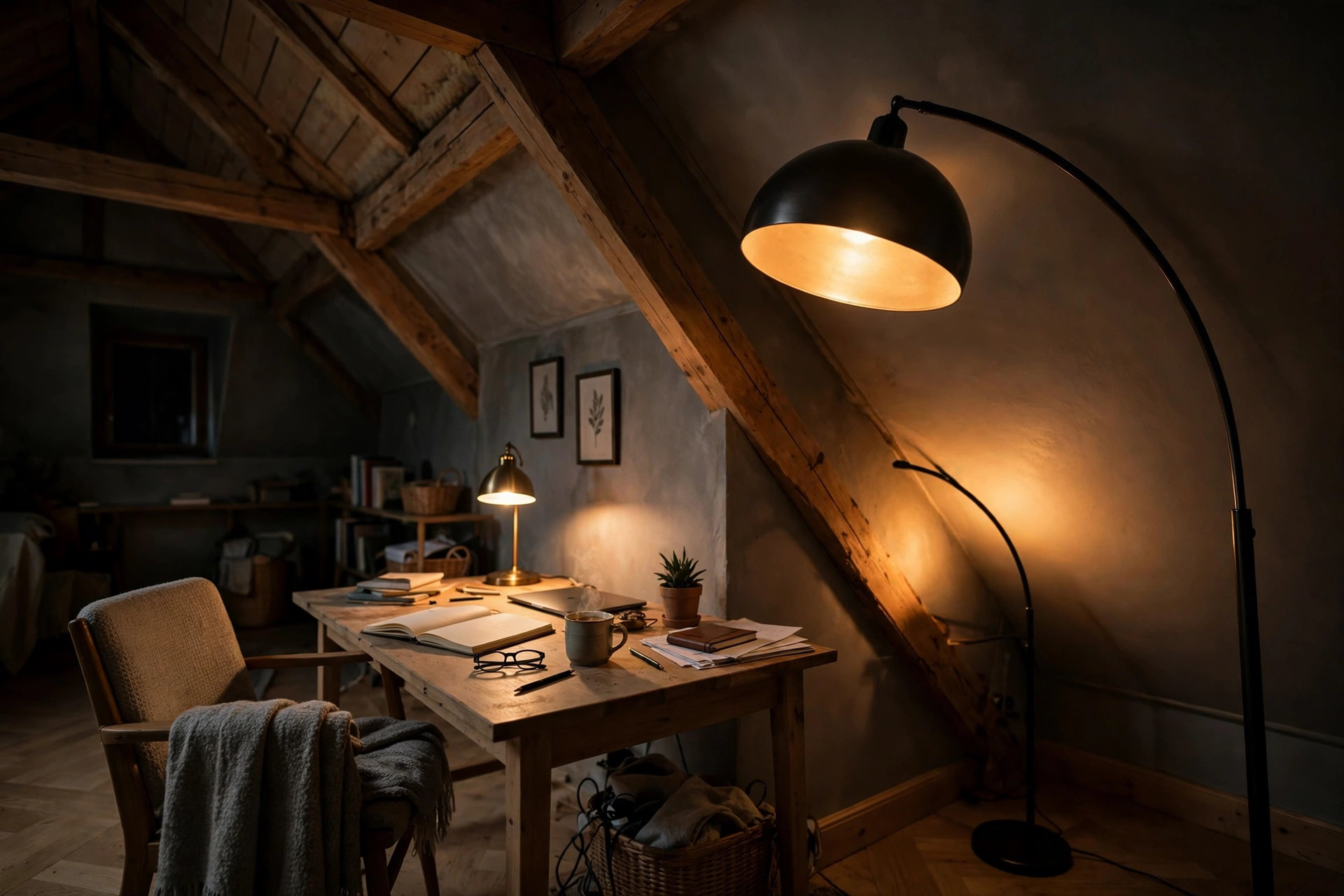
5. Give the far corner a floor lamp
Every windowless attic has one corner that stays dark, usually opposite the desk where the roof is lowest — and it sits in your peripheral vision all day, making the room feel smaller.
A tall, slim uplighter in that corner fixes it — light bounces off the slope and spreads. It also doubles as your video-call light, so half your face is not in shadow. Typical range: about $40–$120. Measure first — under a low slope, a short lamp or wall light fits better than a tall one.
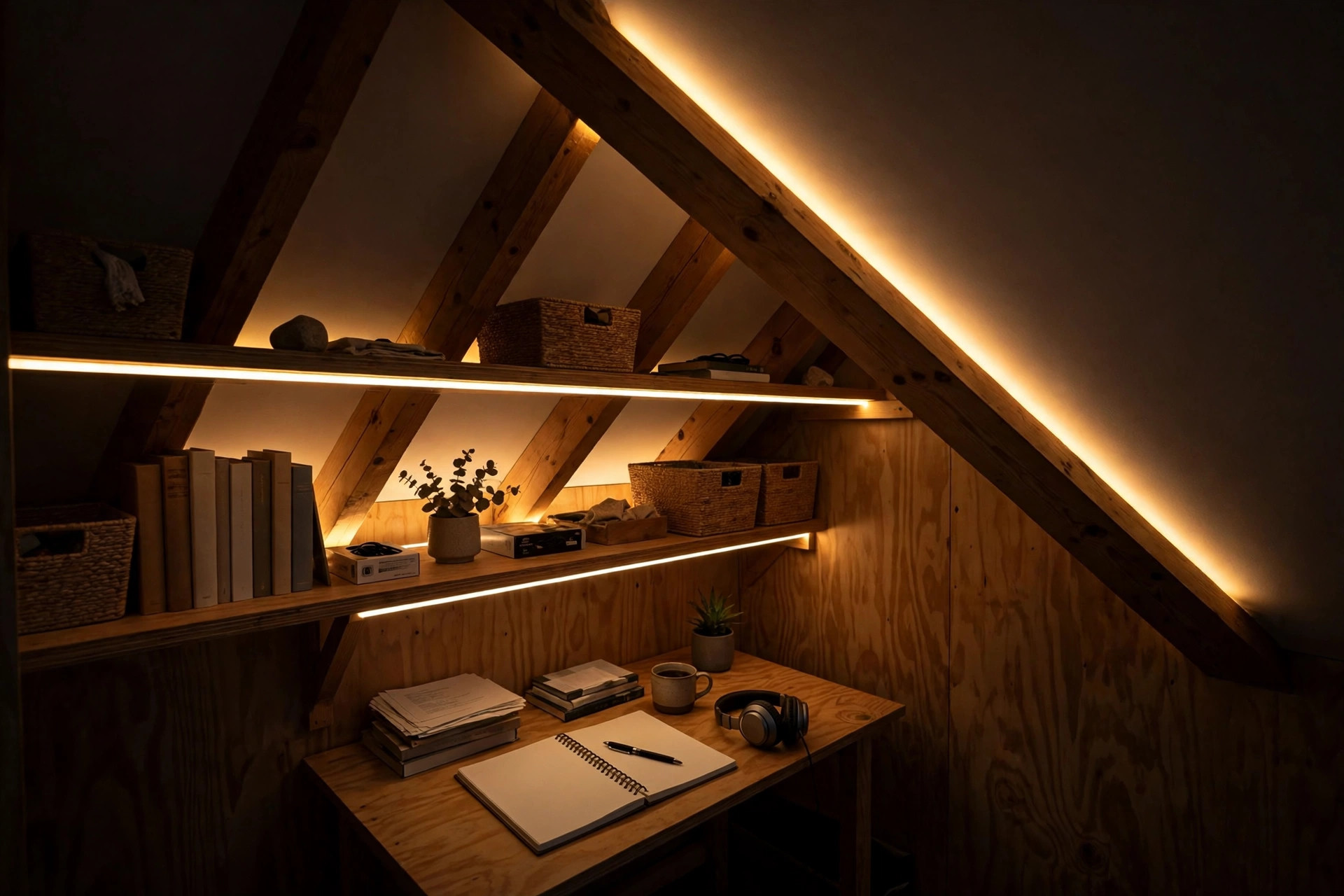
6. Run LED strips along the slope or under shelves
LED strip lights are the cheapest way to put light exactly where a windowless attic has none: along the edge where the sloped ceiling meets the wall, under a shelf above the desk, or behind a low bookcase. They turn dead lines of the room into soft lines of light.
Use warm white (around 2700K–3000K) on a dimmer or smart plug, so they stay low in the background. Typical range: about $15–$35 a reel. Hide the strip itself and show only the glow — visible bare strips look unfinished.
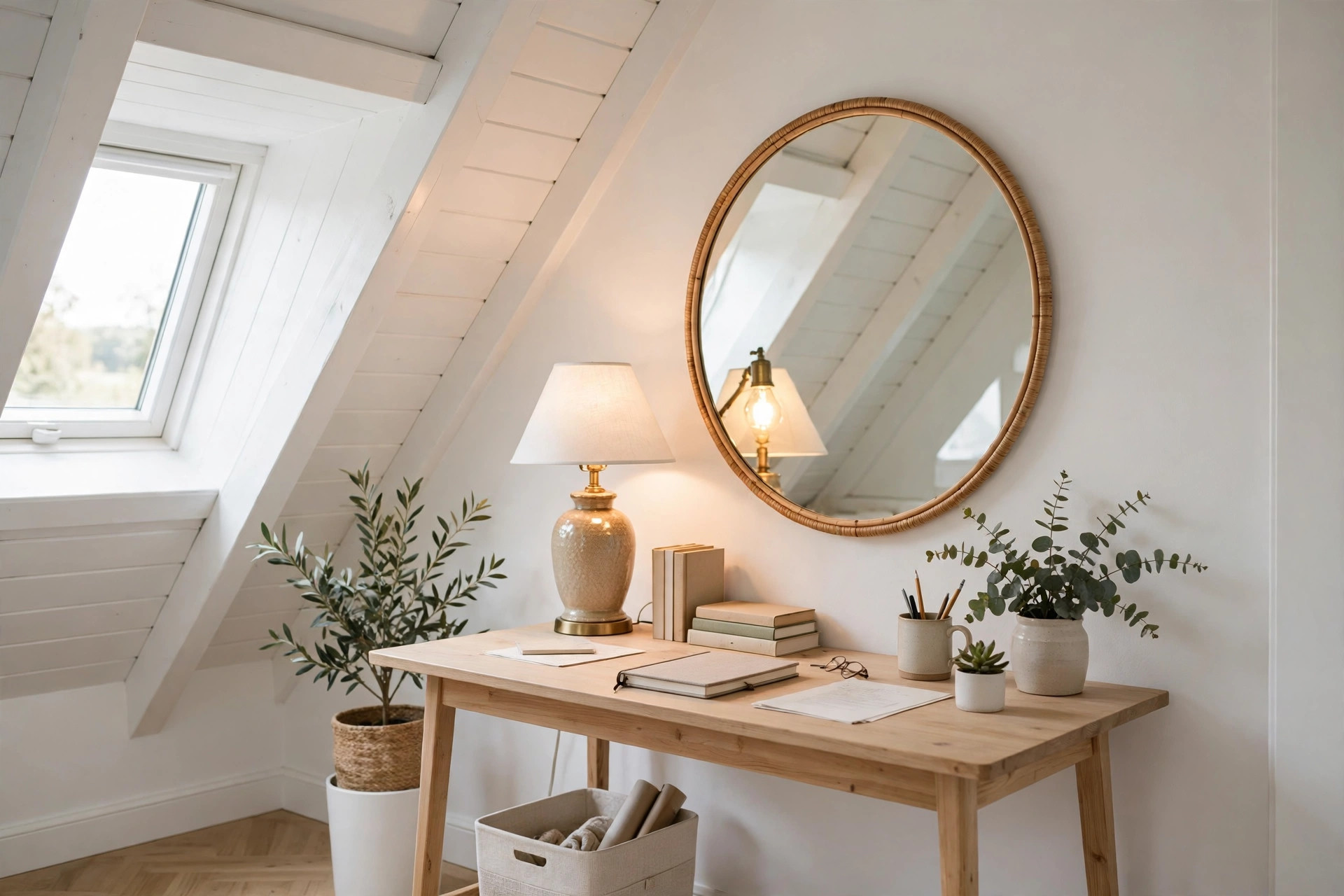
7. Paint it light and add a mirror
Light you already own is worth more in a pale room. Dark panelling and deep-coloured walls swallow light; a light warm white on walls and ceiling bounces it back. In a windowless attic this one change can matter as much as adding a whole fixture.
A mirror opposite your desk lamp or floor lamp does the same on a smaller scale, throwing light back across the room. It needs to face a light source, not you. A litre of pale paint is usually the cheapest lighting upgrade on this list.
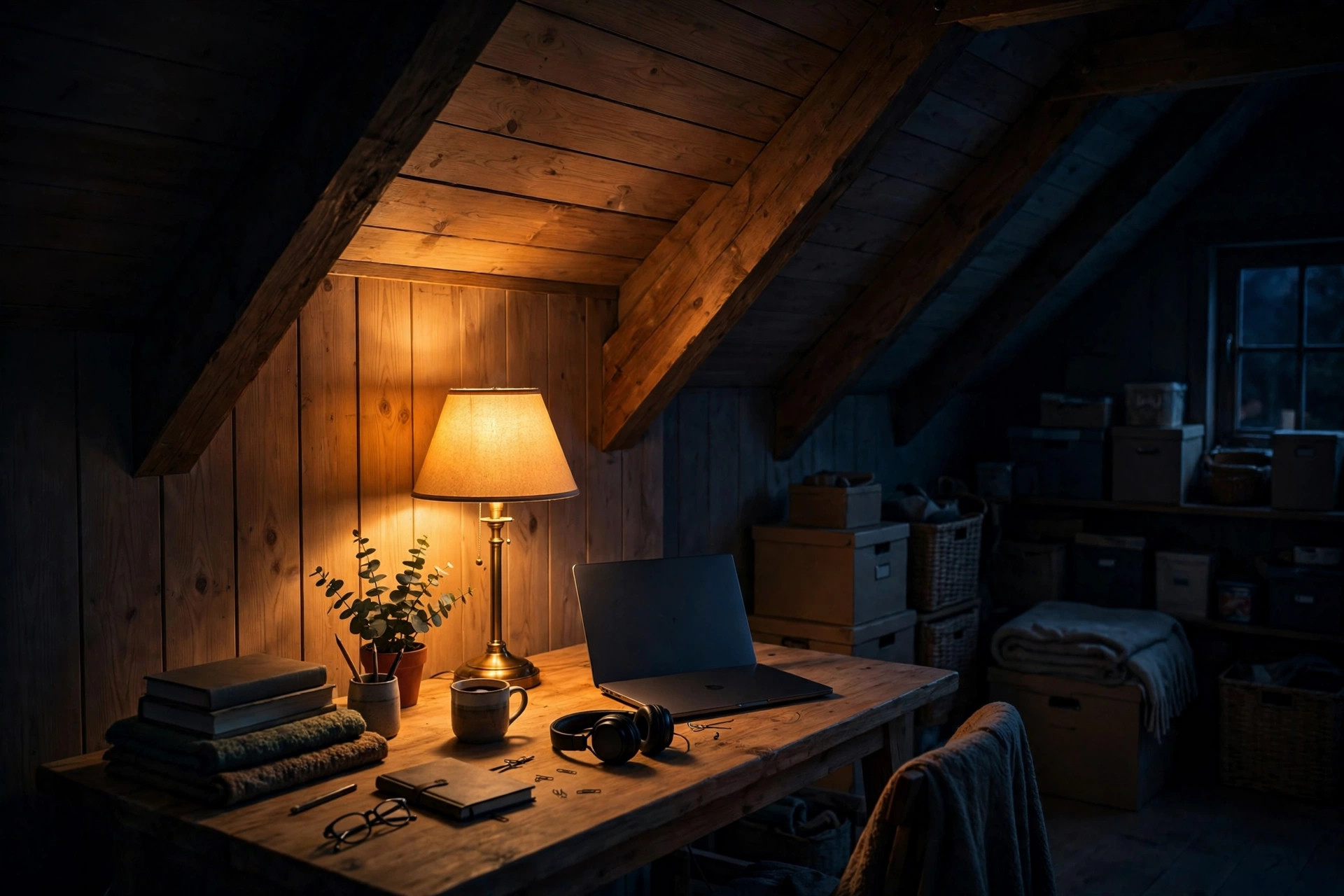
8. Use daylight bulbs for work hours, warm light for evenings
Colour temperature does the job daylight normally does — and most people never touch the setting. For focused work, daylight-style bulbs around 5000K–6500K keep you alert and make colours and text look accurate. In the evening, switch to warm light around 2700K so the room stops feeling like an office and your eyes can wind down.
Adjustable-temperature bulbs in your main fixtures, or one smart bulb in the desk lamp, give you both. If you can only change one fixture, change the desk lamp — it is the light closest to your eyes. Skip cool daylight late at night — with no sunset in the room, the bulbs have to signal the day is over.
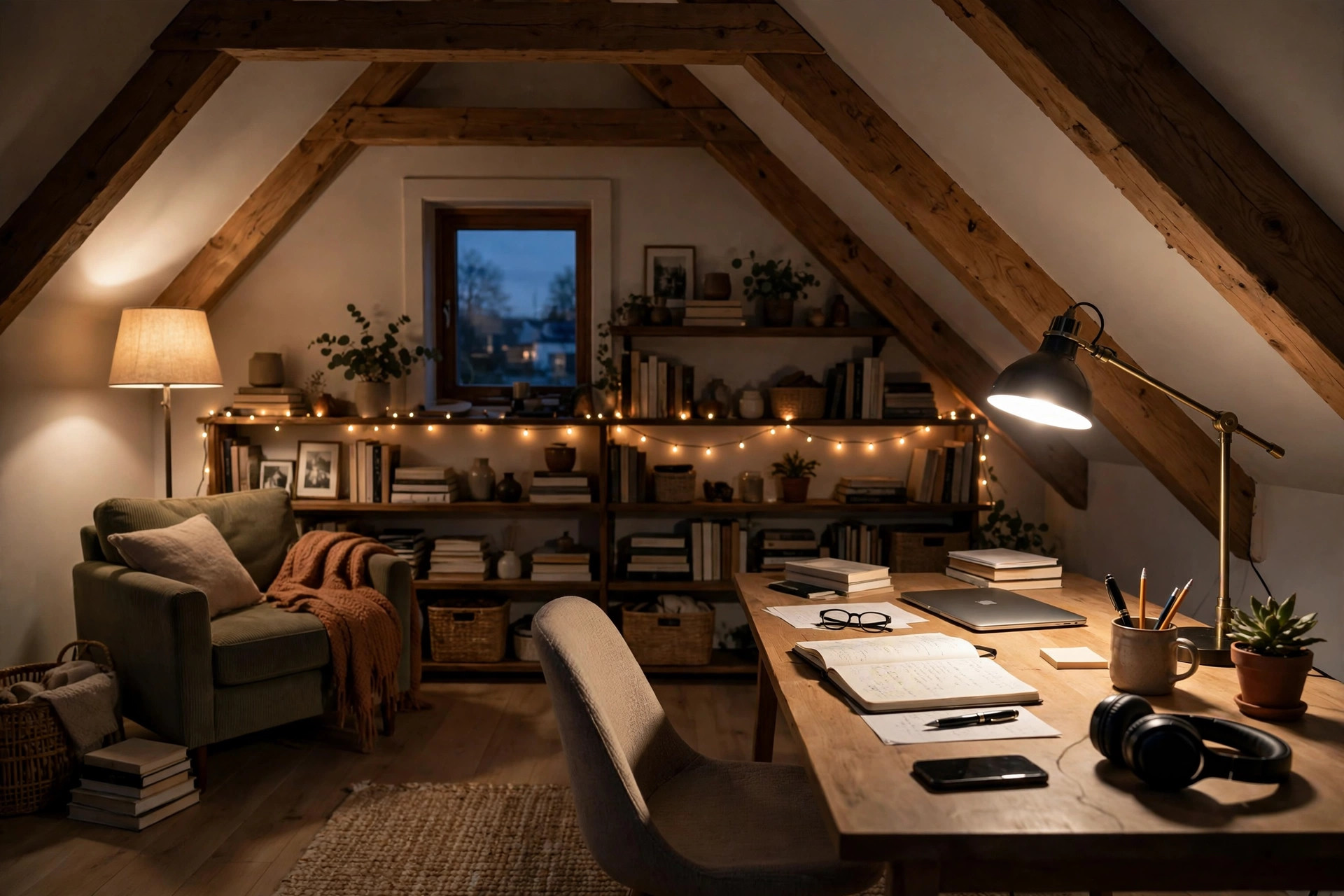
9. Put it on dimmers and zone it
One switch for the whole attic is the enemy: every light fully on or fully off means either too much glare or darkness.
Split the room into zones — ceiling, desk, corner — each on its own dimmer or smart plug: ceiling low, desk lamp bright, corner lamp on for calls. Smart bulbs (about $10–$25 each) are the easiest retrofit where there is no dimmer; a plug-in dimmer does the same for a floor lamp.
What to avoid
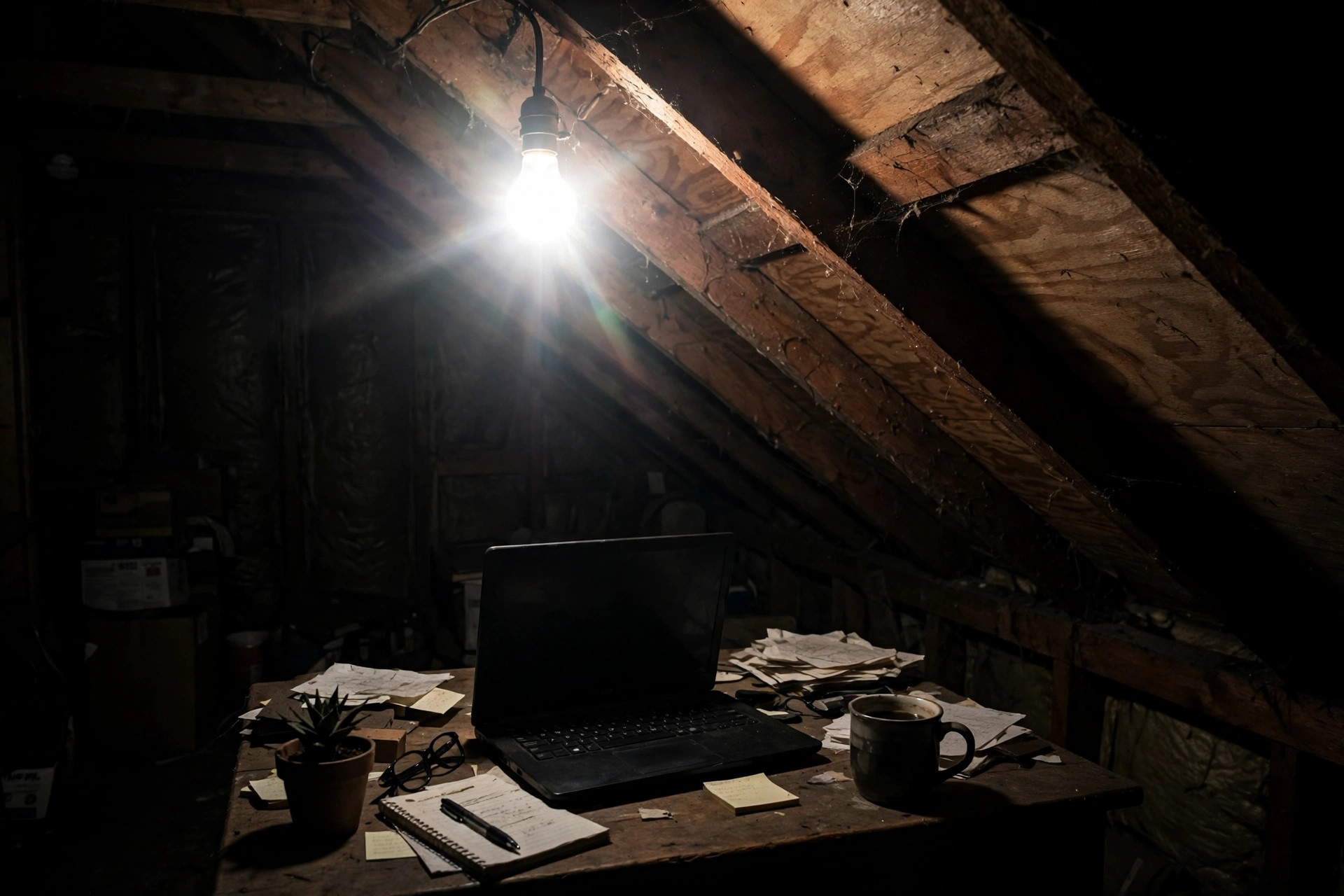
- One bare bulb in the middle of the ceiling. Harsh shadows, screen glare, dark corners — everything this list fixes.
- Cool-white light everywhere, all day. Fine in the morning; tiring by evening, and it makes the room feel like a storage unit.
- A light directly behind your monitor. It silhouettes your screen. Light the wall beside or above it instead.
- Chasing brightness instead of evenness. Three modest lights at different heights feel brighter than one very bright one. Even beats bright.
If you can only buy one thing
Buy the adjustable desk lamp (idea 2). It is the only item here that changes the light exactly where your eyes work. Next, add the ceiling panel (idea 1) for the base layer, then the wall wash (idea 4) — that trio covers most windowless attics, and everything after it is refinement.
Once the lighting is sorted, the next decision is where the desk itself goes. Our guide to where to put your desk in an attic office covers the sloped-ceiling placement that makes this lighting work best. And the 12 attic home office ideas roundup covers layouts and storage for the rest of the room.
A windowless attic will never have daylight — but with a ceiling base, a task light, and the corners filled, it does not need it. It needs layers, in the right order.