Attic Knee-Wall Storage: 11 Office Ideas
The lowest part of an attic is the most wasted. Where the sloped roof meets the floor, the vertical wall — the knee wall — hides a triangle of dead space behind it. In most attic offices that triangle holds nothing but dust and a lost cable. It is also the best storage in the room: out of the way, close to the desk, and big enough to swallow the clutter that makes a small office feel smaller than it is. These 11 ideas turn that dead triangle into working storage — measure first, sort second, build third.
What a knee wall actually is
The knee wall is the short stud wall, usually 3 to 5 feet high, that runs along the side of an attic where the roof slope comes down toward the floor. Behind it is the eave space — a long, low triangle that runs the length of the roof. In an unfinished attic it is open; in a finished one it is usually sealed with drywall and forgotten. The space behind a typical knee wall is 2 to 4 feet deep at the floor, narrowing to nothing at the roof. That is too low to stand in, but it is exactly the right size for drawers, shelves, and bins — the things an office needs within reach but out of sight.

Before you plan anything, check whether the space behind your knee wall is empty or filled with insulation, wiring, or ductwork — a look through an access panel tells you. Never cut into a knee wall blind: wires and pipes often run through that triangle.
Measure first: the 3 numbers that decide everything
Every idea below depends on three measurements. Get them right once and the rest is easy.
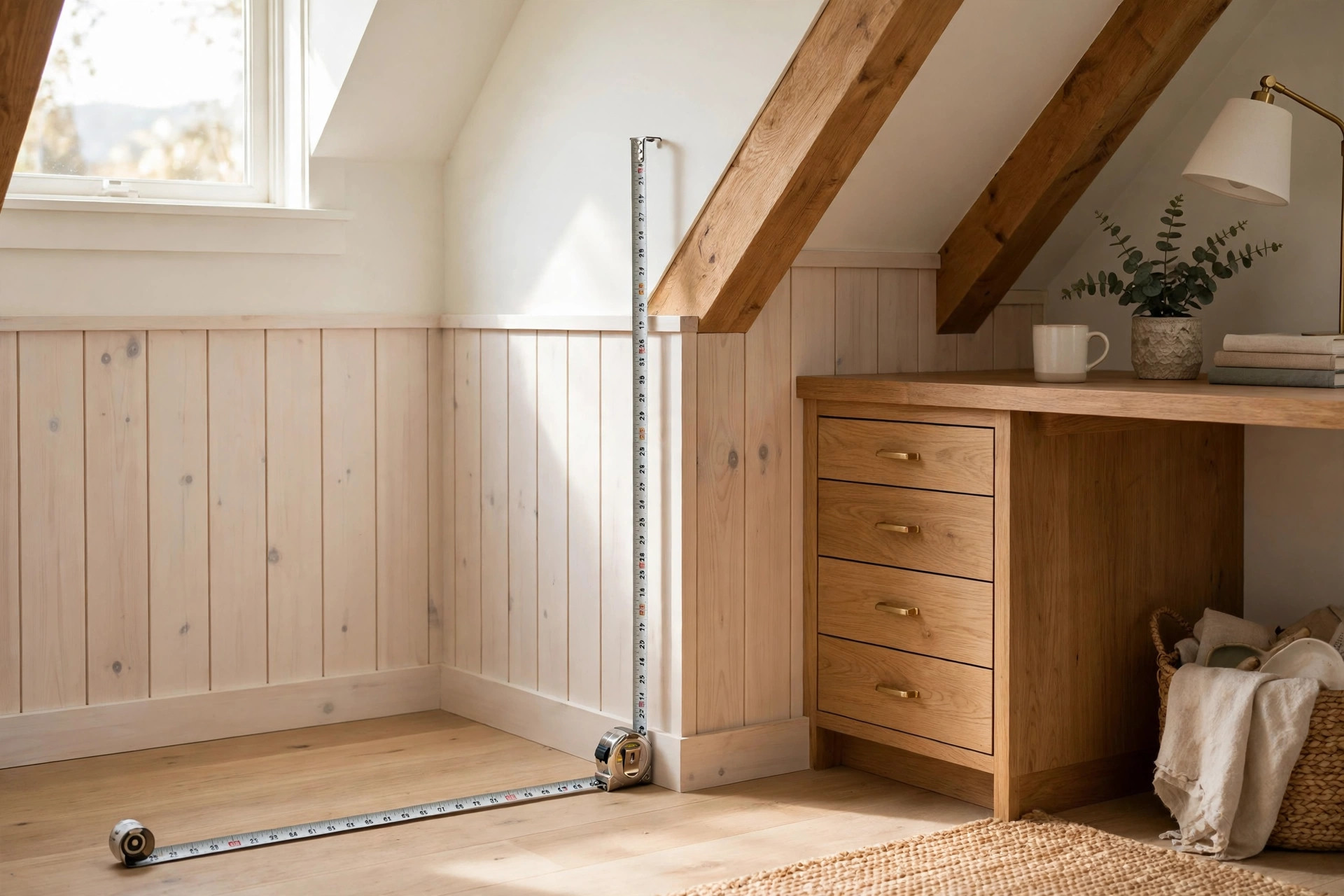
- Height at the wall — the knee wall’s height from floor to where the slope starts. This decides whether you get drawers (needs about 2 feet), shelves, or just shallow bins.
- Depth at the floor — how far back the triangle runs before the roof meets the floor. This decides how deep your storage can be.
- Access width — how wide an opening you can make without cutting a stud. Studs are usually 16 inches apart, so a single-bay opening is about 14 inches wide; a double bay is about 30 inches. Wider openings need framing work and are a job for a carpenter, not a first weekend project.
The 11 ideas
1. Built-in drawers on full-extension slides
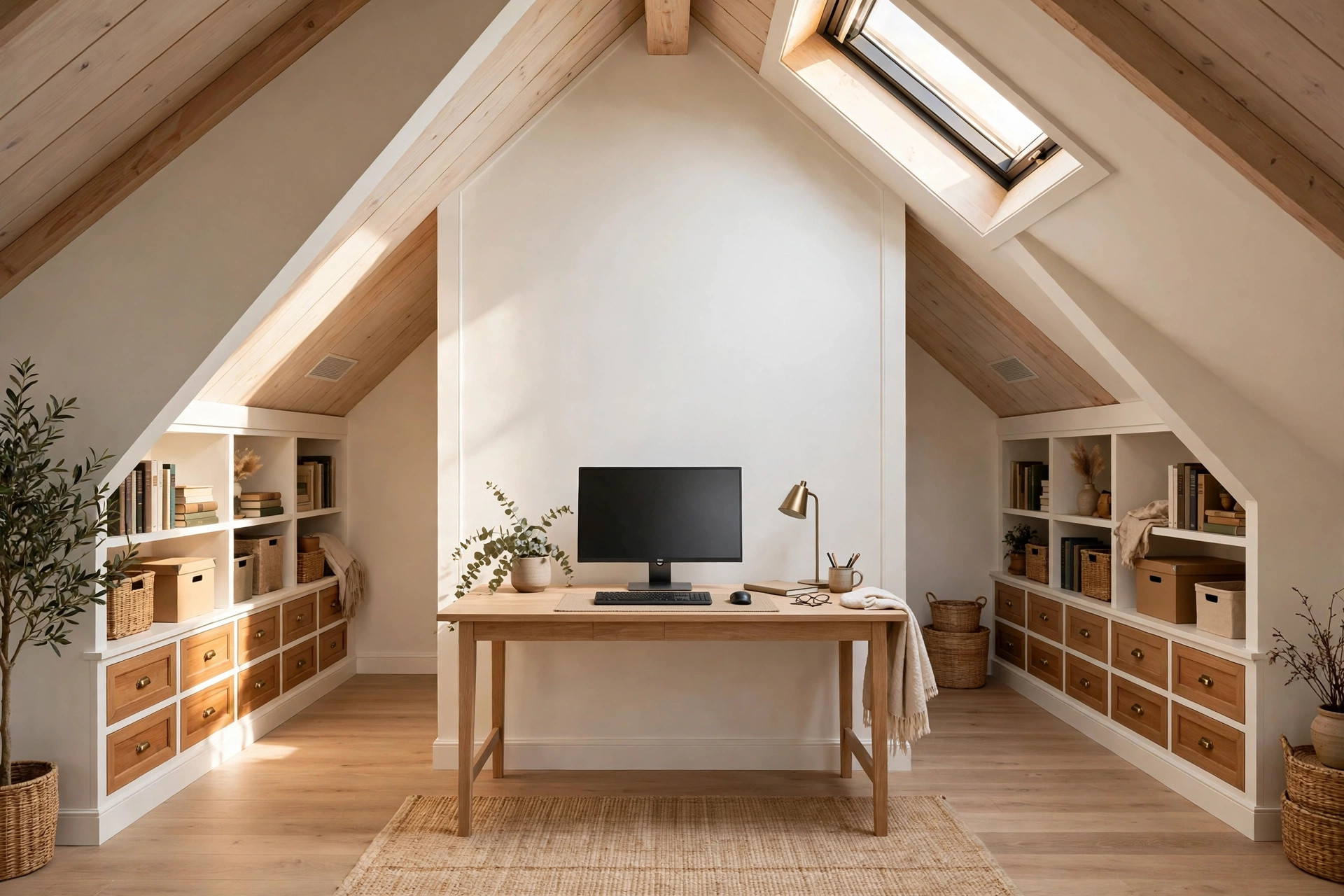
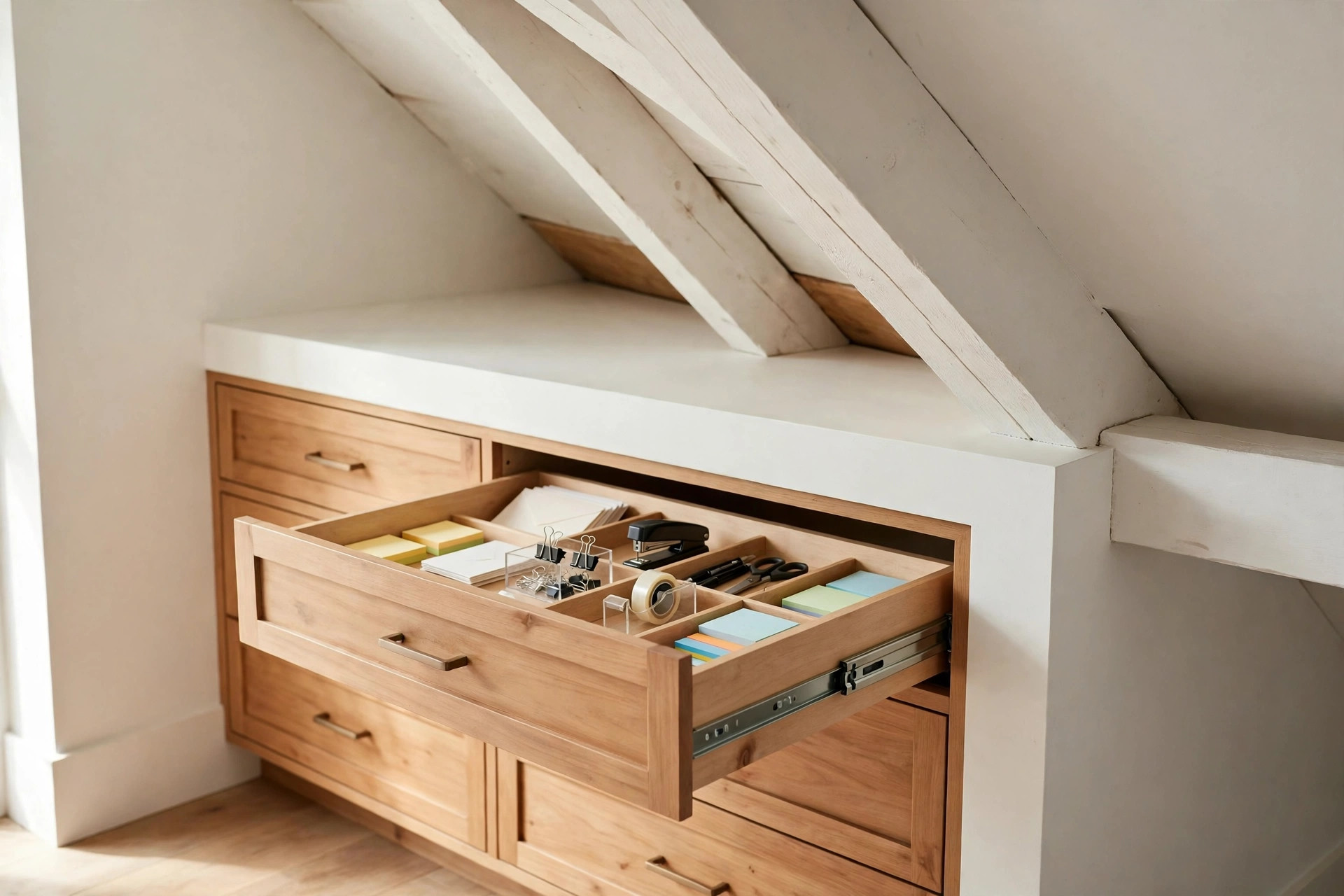
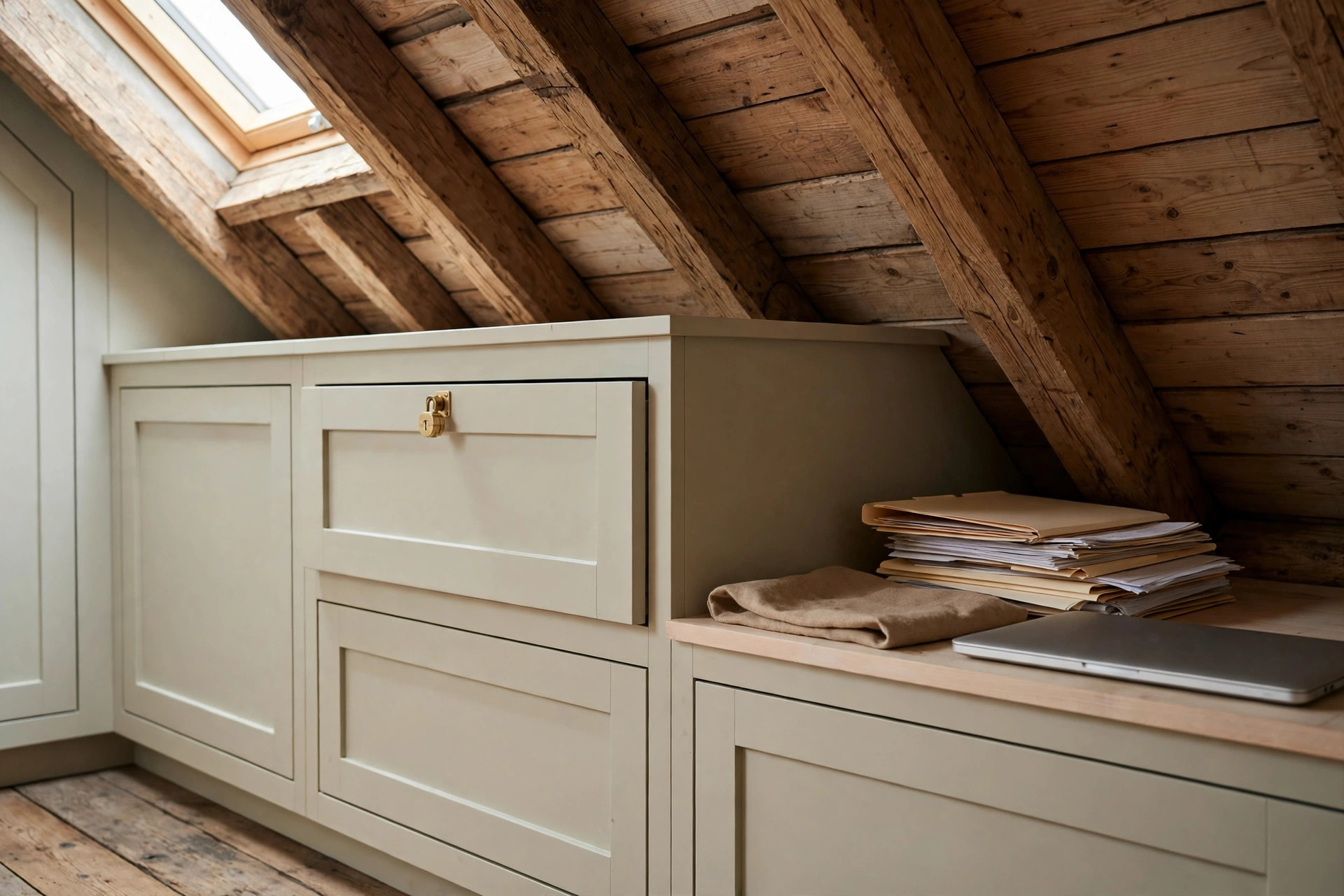
Drawers are the single best use of knee-wall space, because the triangle is deep at the floor and shallow at the top — exactly the shape of a drawer stack. Full-extension slides matter here: a drawer that only opens halfway leaves the back third unreachable, which defeats the whole point. A stack of three or four shallow drawers holds stationery, chargers, notebooks, and the small things that otherwise live on the desk. Broad cost: ready-made drawer units for a single stud bay run roughly $60–$150 each; a carpenter-built run along a full wall is typically a few hundred dollars, depending on length and finish.
2. Open cubby shelves for books and binders
If you reach for something every day, a door is just friction. Open cubbies — simple boxes with no doors — work for books, binders, and the files you actually open. Keep the tallest cubby at the tall end of the triangle and the shortest at the low end, so nothing is buried.
3. A pull-out printer shelf
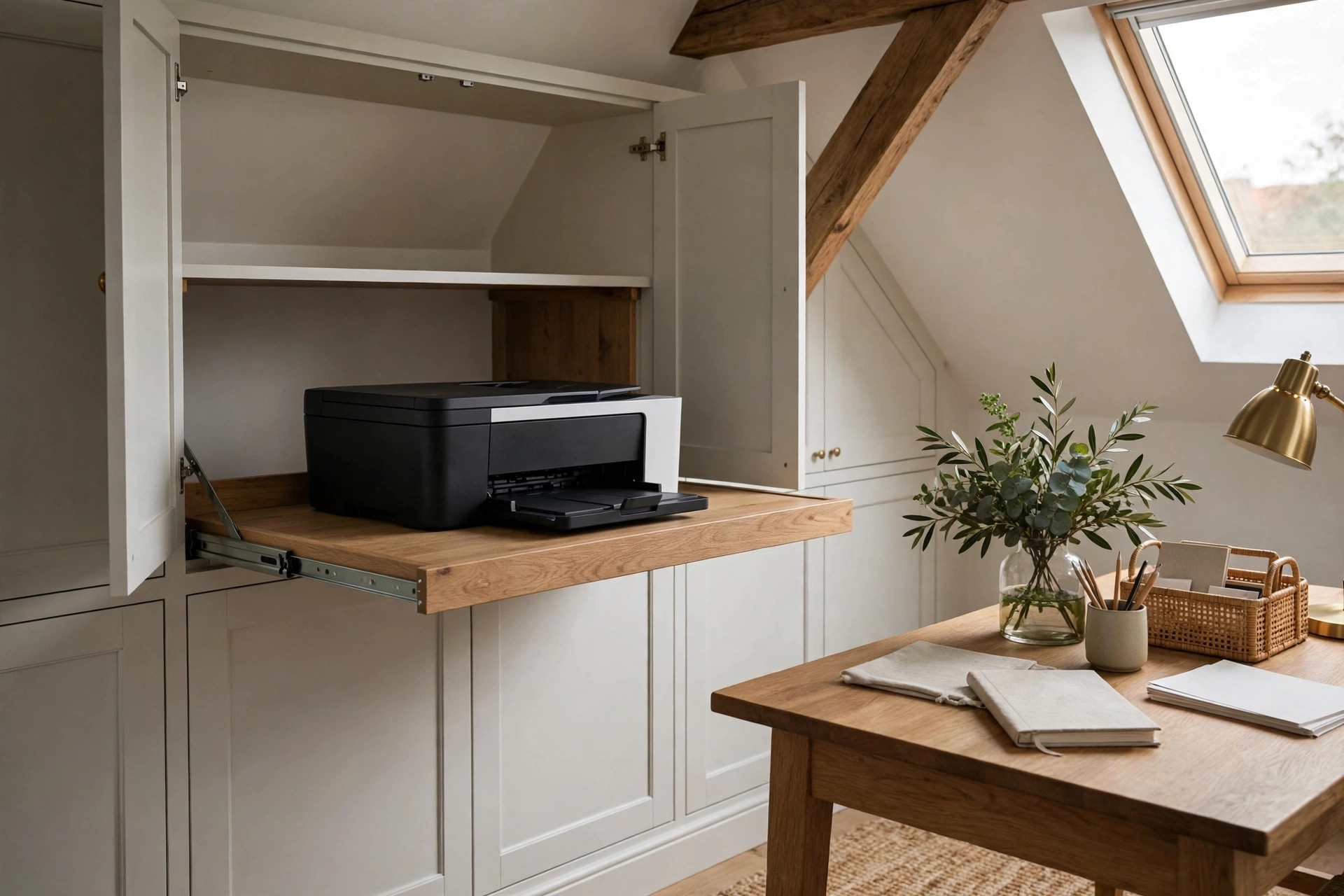
Printers are the classic attic-office problem: too big for the desk, too used to banish to another room. A pull-out shelf inside the knee wall solves it. The printer lives behind a small door or an open bay, slides out on heavy-duty slides when you need it, and slides back when you don’t. Leave room for the paper tray to open and for the cable to travel — a loop of slack cable keeps it from snagging.
4. Filing drawers for the paper you must keep
Some paper still has to exist: tax records, contracts, warranties. A filing drawer behind the knee wall keeps it in the office without eating desk space. Use hanging files, label the tabs, and keep one drawer for “this year” and one for “archive”.
5. A hidden cable and router nook
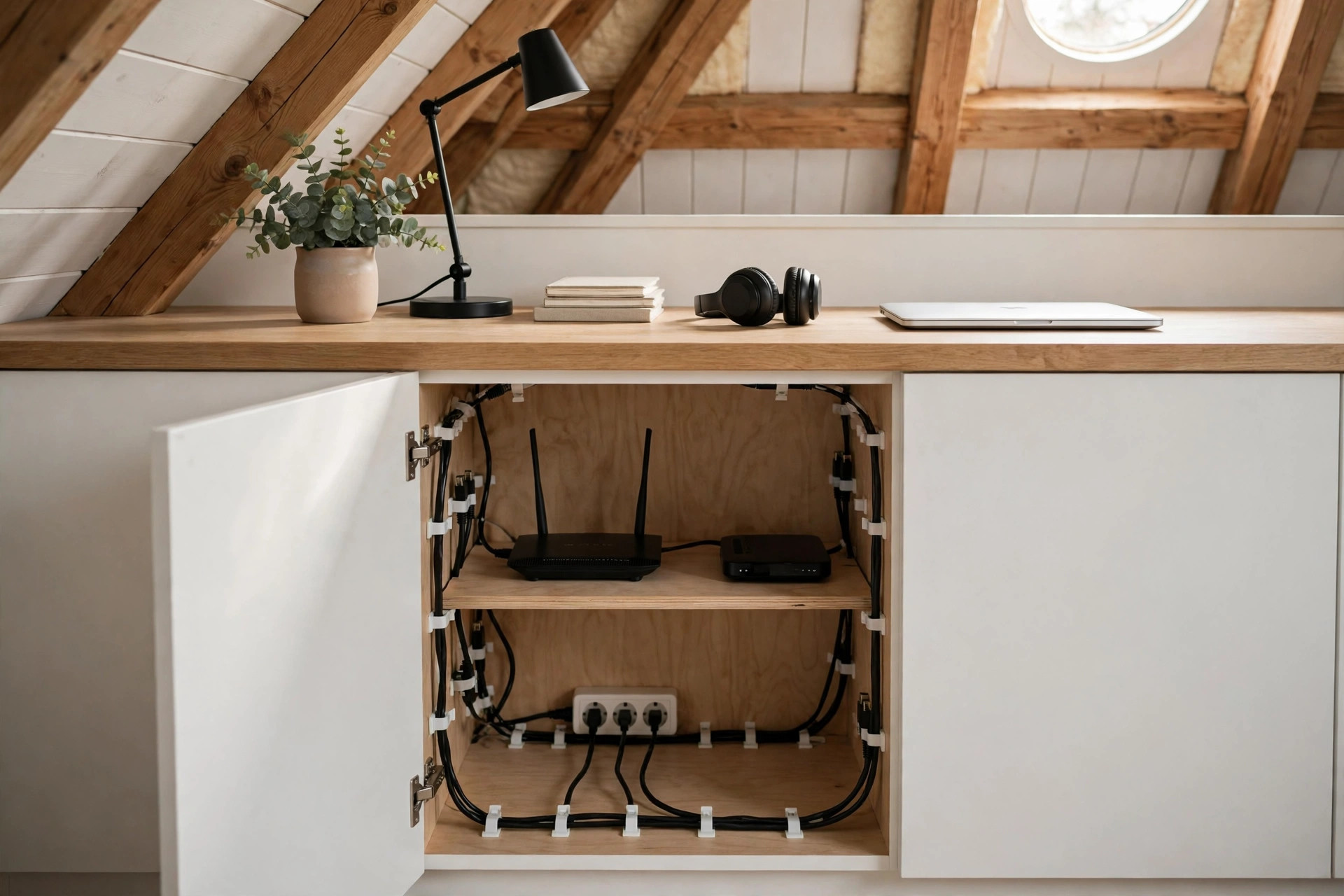
The router, the modem, the power strip, the tangle of chargers — they all need a home, and the knee wall is the tidiest one. A small open bay with a power outlet inside becomes the charging and network corner: router on a shelf, power strip screwed to the side wall, cables clipped in runs. Two cautions: routers need airflow, so never seal one in an airtight box, and never put a power strip where it could sit in a puddle if the roof ever leaks — mount it off the floor.
6. Seasonal and archive bins, labelled
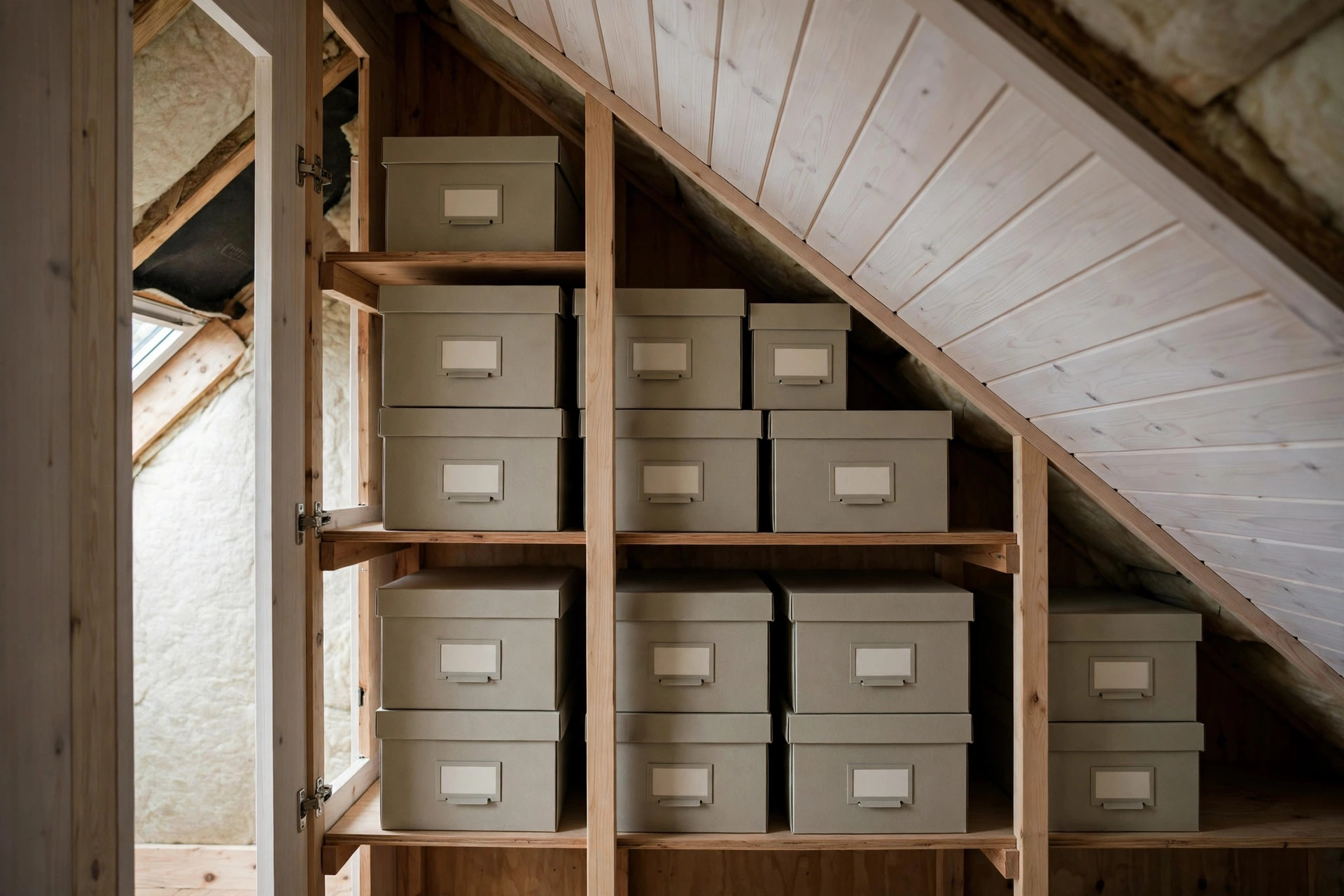
The deepest, lowest part of the triangle — the part you can only reach on your knees — is for things you need twice a year, not twice a day. Clear bins with a label on the end you can see: old tax years, spare cables, event materials, seasonal office gear. Clear beats opaque here, because you will be reading the label in dim light from an awkward angle.
7. A craft and hobby cubby wall
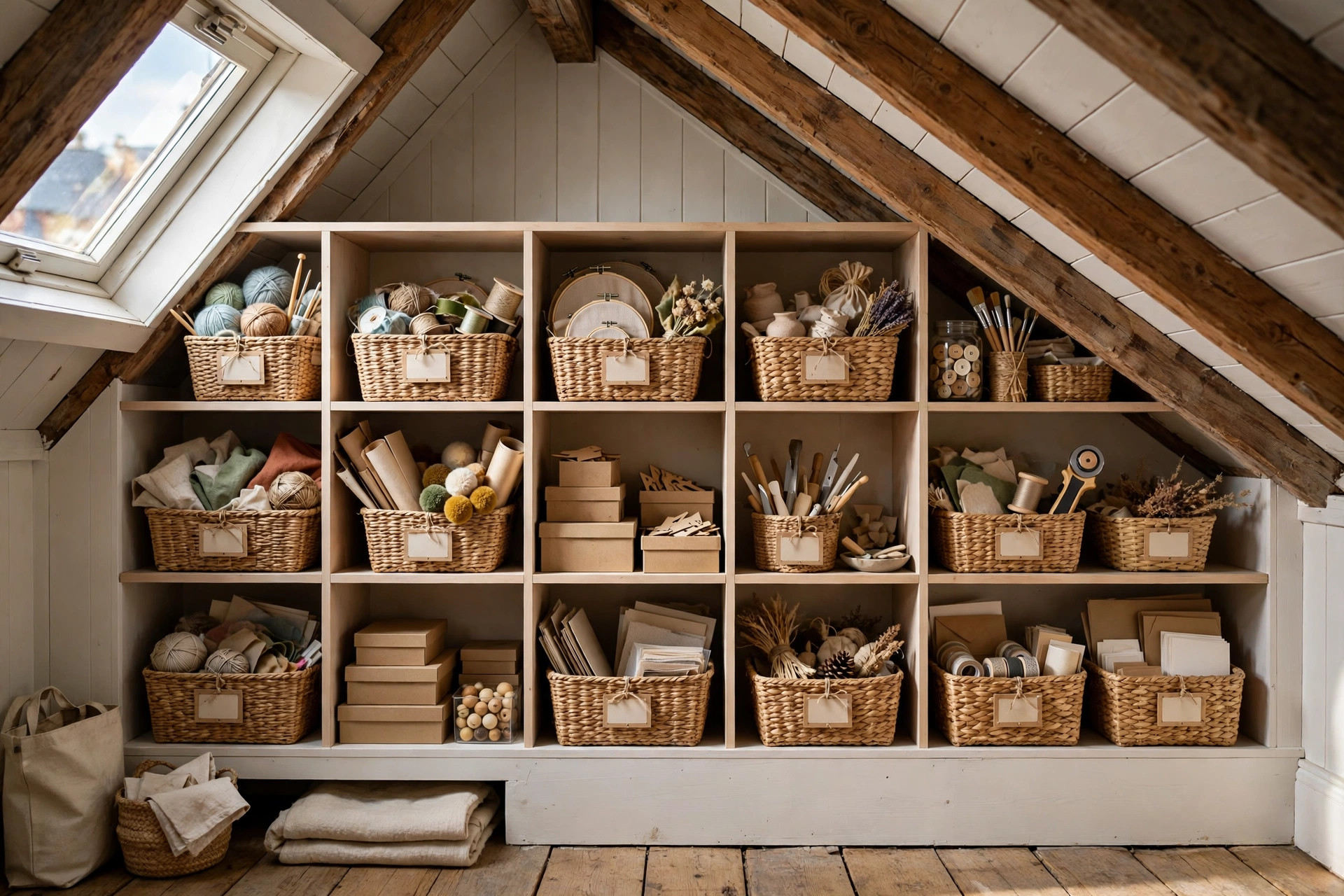
If the office doubles as the place where you make things, the knee wall can take the hobby too. A wall of small cubbies — each one a basket or a tray — holds yarn, fabric, tools, sketchbooks, or model parts, sorted by project. Keep the current project at the tall end where you can reach it sitting down, and the waiting projects at the low end. If a cubby hasn’t been opened in three months, its contents belong in a bin (idea 6), not on display.
8. A drop zone by the office door
The knee wall nearest the door is the best place for the things that arrive and leave with you: bag, headphones, laptop sleeve, the notebook you carry to meetings. A couple of hooks on the wall face and a shallow shelf inside the bay make a drop zone that keeps the desk clear and the floor walkable.
9. Display ledges for plants and prints
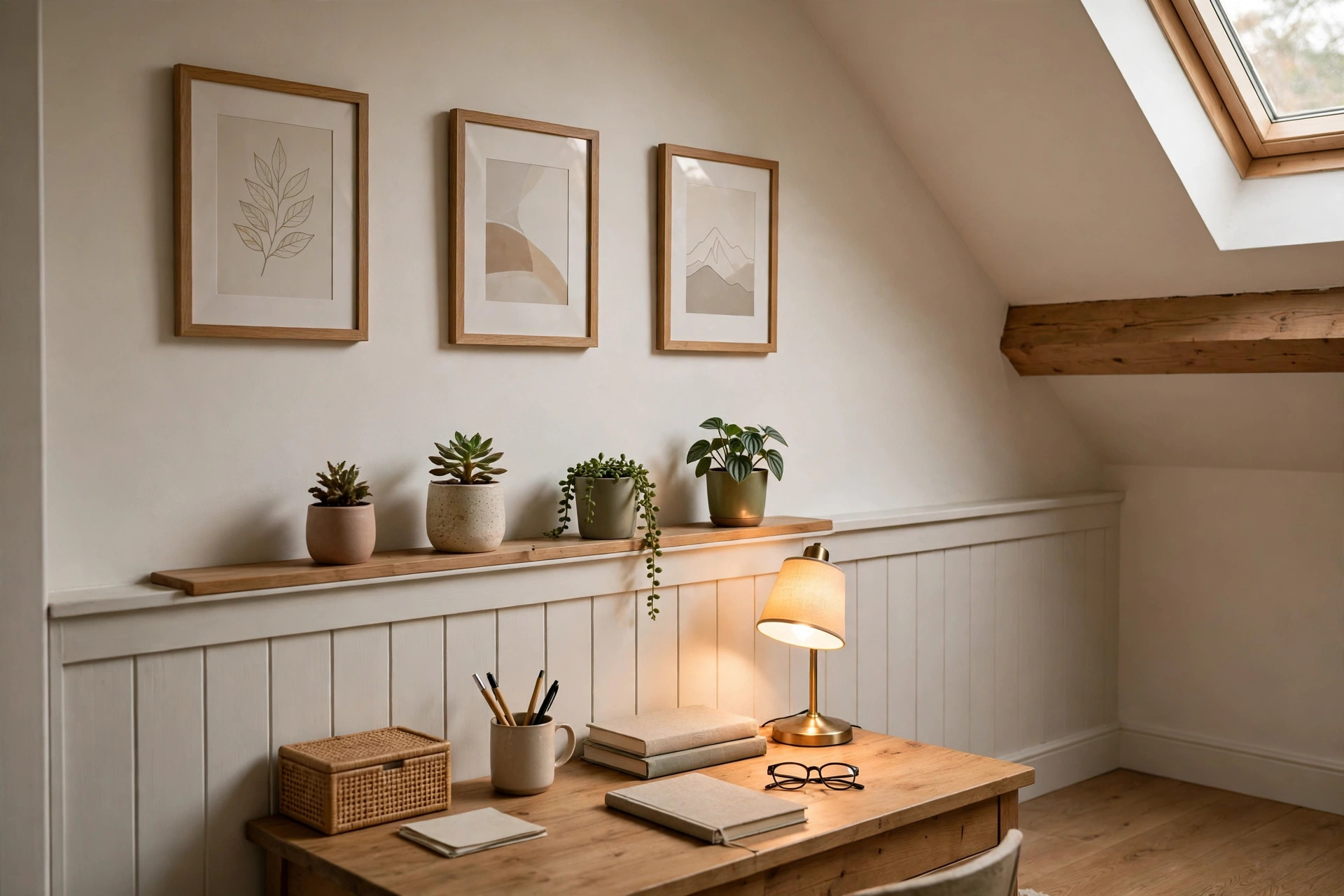
Not all knee-wall space has to be hidden storage. A shallow ledge on the wall face — 3 to 4 inches deep — holds a small plant, a framed print, or a couple of books with the cover facing out. It softens the wall, gives your eyes somewhere to rest on video calls, and costs almost nothing. Keep it shallow and light: the ledge is decoration, not a shelf, and anything heavy belongs in a drawer.
10. A homework shelf for shared rooms
If the attic office shares the room with a child’s homework corner, give the homework its own bay. One shelf for books, one cubby for the pencil case and charger, and a rule everyone understands: homework lives in the bay, not on your desk.
11. A lockable drawer for valuables and documents
Passports, a spare drive, the contract folder, a small amount of cash — the things you would miss first. One lockable drawer, in the bay nearest the desk, with a simple cam lock. It does not need to be a safe; it needs to be the one drawer a visitor cannot casually open.
What not to store behind a knee wall
Some things should not live in the triangle. Anything heat-sensitive — spare batteries, candles, film, vinyl — because an attic runs hotter than the rest of the house in summer. Anything that hates damp — important paper without a sealed box, if your roof has ever leaked. And paint, solvents, or anything flammable: the knee-wall space is enclosed and warm, the worst combination for them.
The order to do it in
Do it in this order and you will not redo anything.
- Measure — the three numbers, plus a check for wires, pipes, and insulation behind the wall.
- Sort — empty the desk drawers and the floor piles into three groups: daily, weekly, twice-a-year.
- Build the tall bays first — drawers and open cubbies — because those change how the room works every day.
- Add the specialist bays — printer shelf, cable nook, lockable drawer — once the everyday storage is working.
- Label everything, then live with it for two weeks before you buy anything else. The second purchase is always better than the first, because by then you know what you actually reach for.
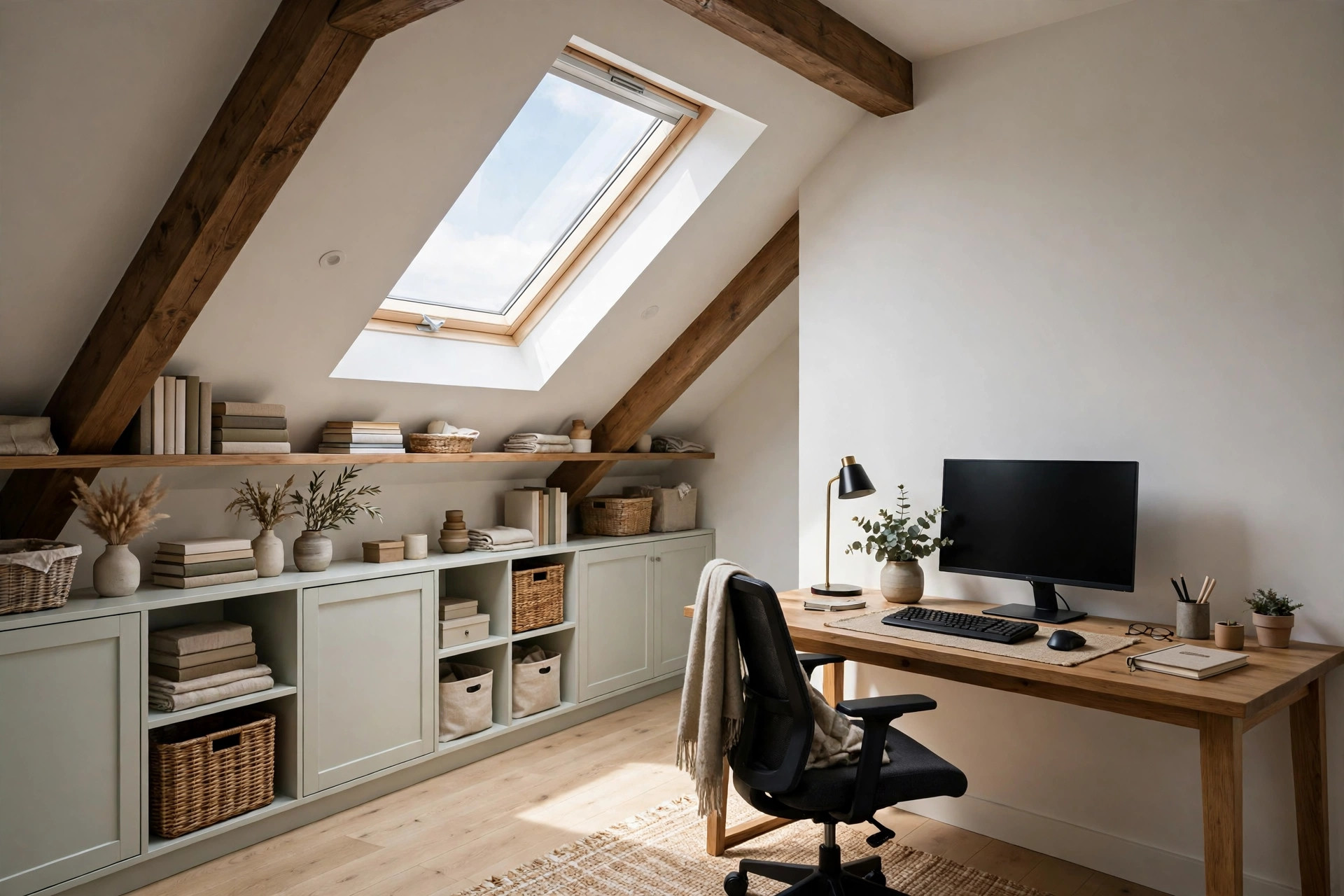
The knee wall is the cheapest square footage in an attic office — space you already own, behind a wall that is already there. Start with the measurements and build the tall bays first. If you are still deciding where the desk itself should go, read our sloped-ceiling desk placement guide first — storage works best once the desk is on the tall wall, not before.