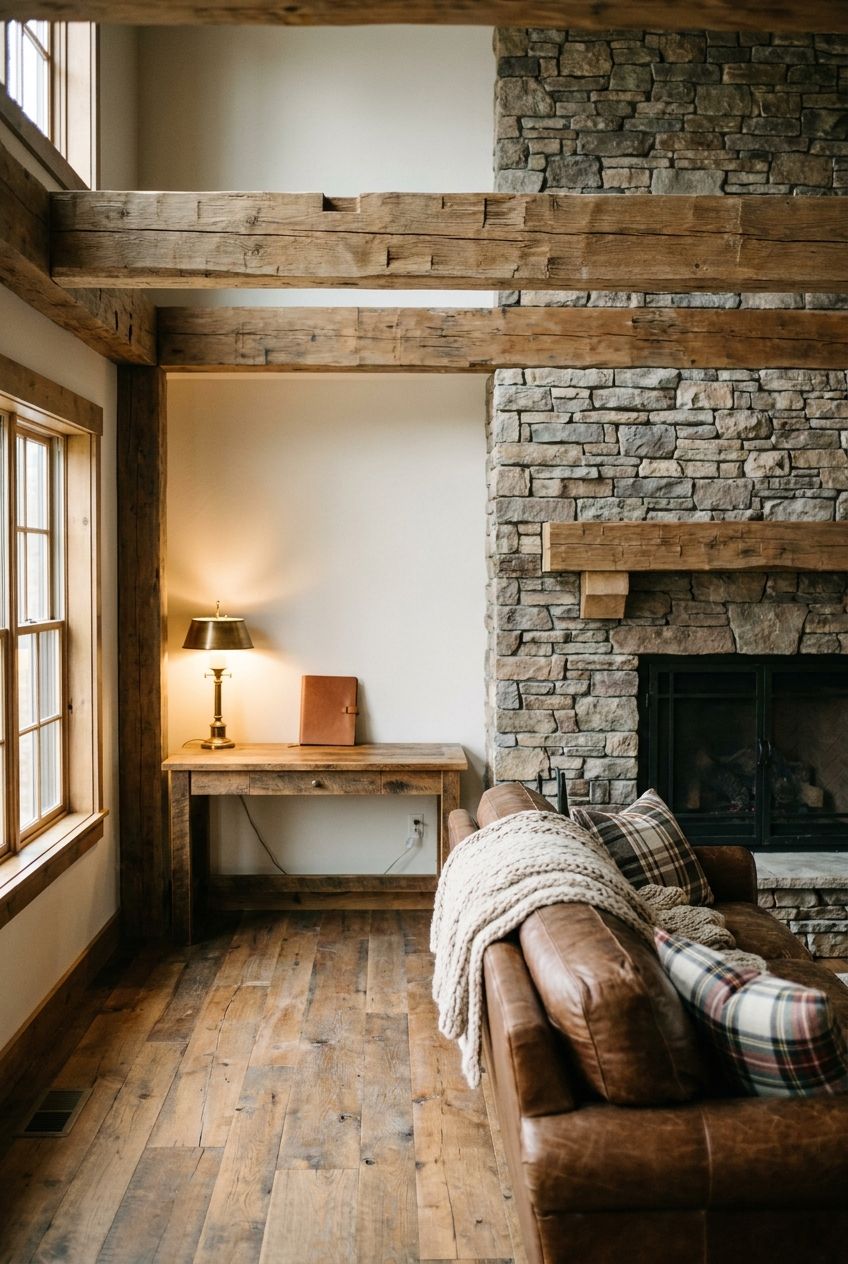
Rustic Living Room With a Home Office: 9 Steps to Build One That Works
Most people who add a desk to a rustic living room make the same $400 mistake: they buy a gorgeous reclaimed-wood desk that wrecks their back within three weeks. A rustic living room can absolutely double as a productive workspace, but only if you treat the work zone as an engineering problem first and a design problem second. This guide gives you the measurements, budgets, product picks, and fixes to get both right.
Why a Rustic Living Room Is Surprisingly Good at Hiding a Workspace
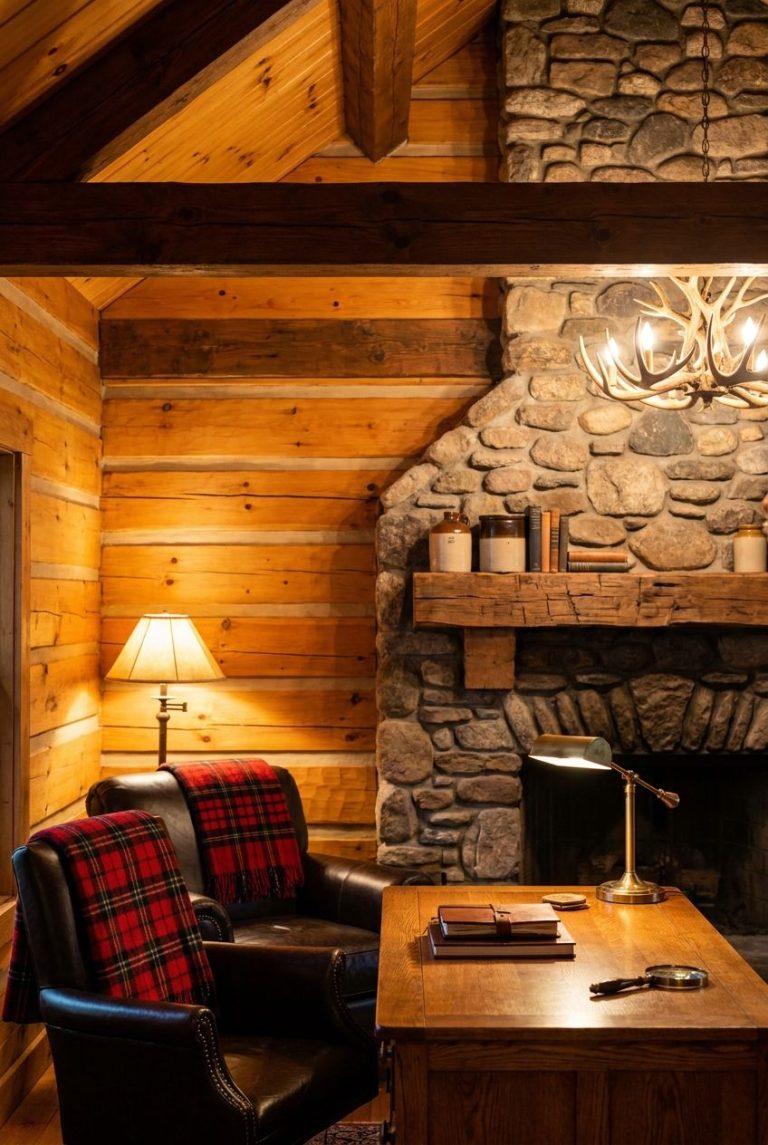
Rustic style leans on chunky wood, stone, leather, wool, and wrought iron. Those materials are forgiving. A thick live-edge desk reads as furniture, not office equipment, so it blends into a room that already has a heavy coffee table and exposed beams.
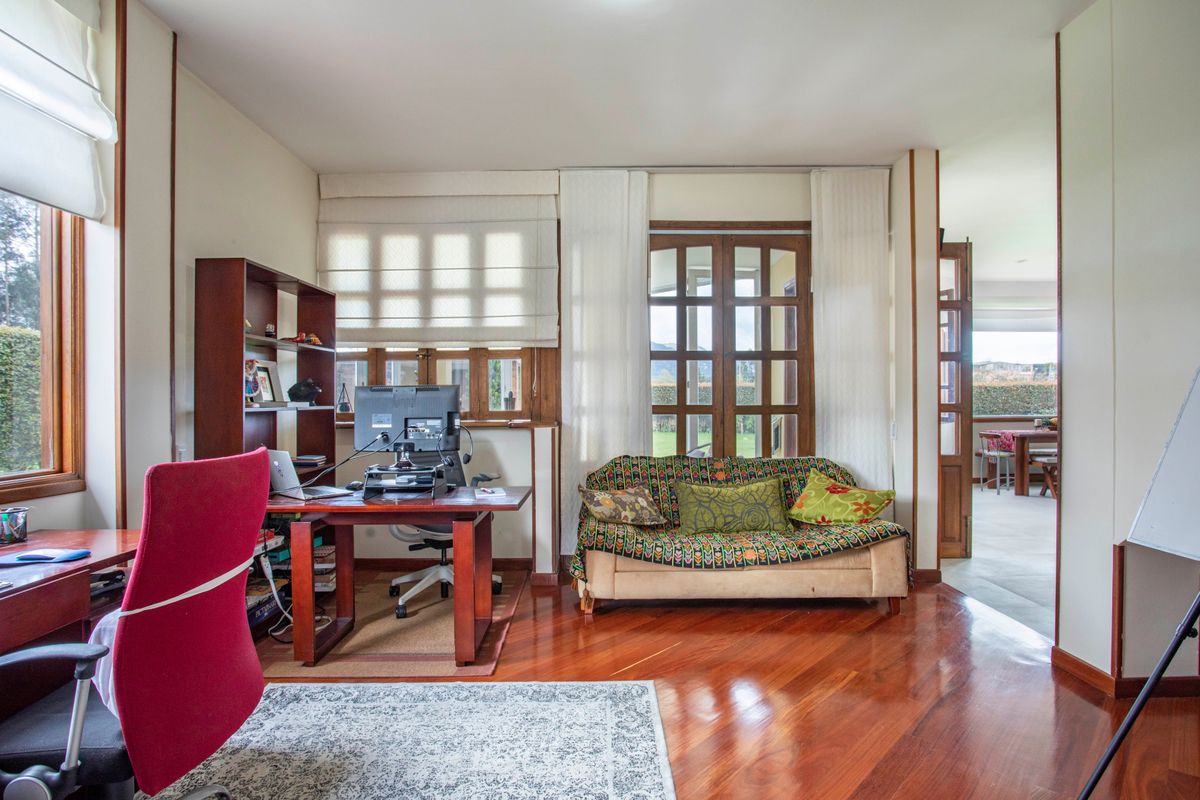
Compare that with a sleek modern living room, where a bulky monitor and cable bundle stick out like a sore thumb. Rustic rooms have visual texture that camouflages tech. A dark walnut-stained desk next to a stone fireplace looks intentional.
The catch is that rustic furniture is often built for looks, not ergonomics. Farmhouse tables run 30 to 31 inches tall, which is fine for dining but about 1 to 2 inches too high for most typing setups. The ideal desk height for a 5’7″ to 5’11” person is 28 to 30 inches.
Here is what you gain by combining the two:
- Warmth that reduces fatigue: Natural wood tones and soft textiles lower the sterile feel of a home office, which many remote workers report as a drain after 6 or more hours.
- Built-in storage opportunities: Trunks, blanket ladders, and cabinets can hide printers, routers, and paperwork.
- Durability: Solid wood and leather age well, so your workspace looks better after 5 years of use, not worse.
- Resale-friendly: No built-in office means the room converts back to a pure living space in under an hour.
Start by deciding whether the workspace is a permanent corner or a fold-away setup. That choice drives every purchase below.
How to Pick the Right Spot in Under 30 Minutes
Do not choose the spot by looking at the room. Choose it with a tape measure, a phone flashlight, and a laptop.

The 4-point spot test
- Measure the footprint. You need at least 48 inches wide by 30 inches deep for a desk, plus 36 inches of clearance behind the chair. Total: roughly 4 feet by 5 feet of floor. But what if your room is small? A 40-inch wall-mounted drop-leaf desk uses only 12 inches of depth when folded.
- Check natural light direction. Sit where you plan to work at 10 a.m. and 3 p.m. Windows should be to your side, not behind your monitor (glare) or directly in front of you (eye strain). But what if the only open wall faces a window? Add a sheer linen curtain, which cuts glare by about 40 to 50 percent while keeping daylight.
- Test your Wi-Fi. Run a speed test at the exact spot. You want at least 25 Mbps for video calls. But what if the fireplace’s stone wall blocks signal? Thick masonry can drop signal by half. Move the router or add a $60 mesh node like the TP-Link Deco X20.
- Count outlets. You need at least three within 6 feet: laptop, monitor, lamp. But what if there is only one? A flat-profile surge protector like the Belkin 6-outlet strip with a 4-foot cord mounts under the desk.
Success looks like a spot where you can sit, plug in, and see the screen without squinting, within 30 minutes of testing. Avoid placing the desk with your back to the room’s main entrance. Research on workplace comfort consistently shows people feel less focused when they cannot see who is approaching.
Best spots, ranked: behind a sofa against a wall (acts as a divider), a window nook, then a fireplace-adjacent corner.
The Rustic Desk Decision: Reclaimed Wood vs. Live-Edge vs. Farmhouse
Your desk is the anchor. It is also where most budgets go sideways, because rustic desks range from $150 to $2,500 for what looks like the same thing in photos.
| Desk Type | Typical Price | Durability | Ergonomic Fit | Best For |
|---|---|---|---|---|
| Reclaimed wood (e.g., Pottery Barn Reclaimed Wood Desk) | $900 to $1,800 | Excellent, 20+ years | Usually 30″ tall, needs a keyboard tray or a lower chair setup | Permanent corner setups where character matters most |
| Live-edge slab (e.g., Etsy makers, Greenington) | $600 to $2,500 | Very good, but may warp without sealing | Fully custom height possible | Statement piece, tall or short users who need custom sizing |
| Farmhouse-style engineered (e.g., IKEA HEMNES with stain, Walker Edison) | $150 to $450 | Good, 5 to 8 years | Often adjustable or 29″ standard | Budget builds, renters, or testing the corner before investing |
| DIY butcher-block on trestle legs | $180 to $320 | Excellent if sealed | Any height you choose | Handy beginners who want a custom size cheaply |
Recommendation by use-case: Choose the DIY butcher-block for the best value (an IKEA KARLBY countertop at roughly $150 plus $60 trestle legs gives you a 74-inch desk at your exact height). Choose reclaimed wood if you want a forever piece. Choose engineered farmhouse if you rent.
Whichever you buy, confirm the depth is at least 24 inches. Anything shallower forces your monitor too close to your eyes, which should sit 20 to 28 inches away.
Seating That Survives Both Eight-Hour Workdays and Rustic Style
Here is the uncomfortable truth: a leather club chair is not an office chair. A 2019 review of office ergonomics from the Cornell University Ergonomics Research Laboratory has long shown that lumbar support and seat-height adjustability matter more than looks for sustained sitting. You need both.
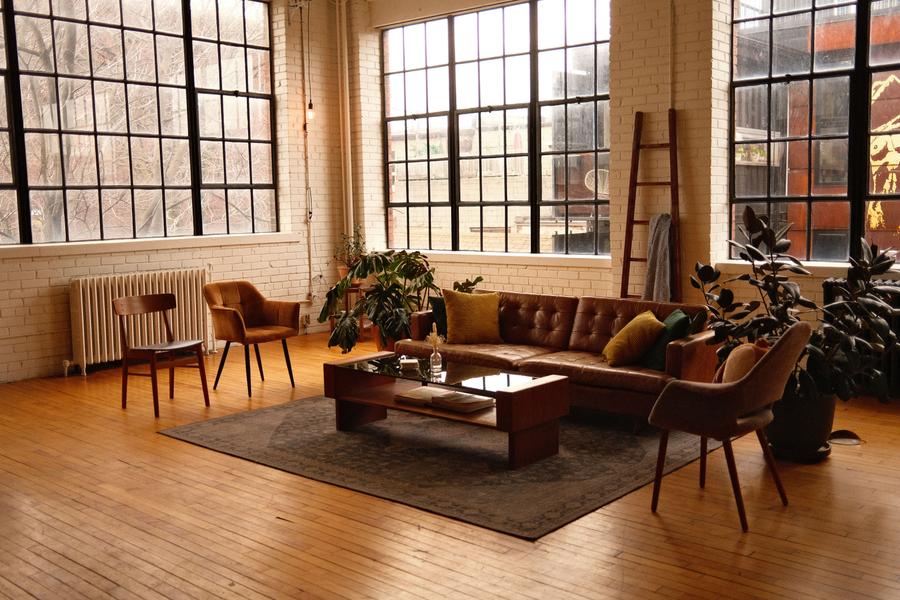
Three ways to get comfort without wrecking the look
Option 1: A rustic-friendly ergonomic chair. The Herman Miller Sayl in a warm neutral, or the Steelcase Series 1 in dark brown, cost $400 to $600 and have clean lines that disappear into leather and wood rooms. Both adjust seat height from about 16 to 21 inches.
Option 2: A leather chair with add-ons. If you love a cognac leather desk chair, add a $35 lumbar cushion (the McKinney Posture Support is a popular pick) and a $25 footrest. This works for work sessions under 4 hours.
Option 3: A split approach. Use a real ergonomic chair at the desk and tuck it away behind a sofa or beside a bookshelf when you are not working. Drape a wool throw over the back to soften the look.
Test any chair against this checklist: feet flat on the floor, knees at 90 degrees, elbows at 90 degrees at the desk surface, and your lower back touching the support. But what if the desk is too high for that? Raise the chair and add a footrest, rather than lowering the desk if you cannot cut the legs.
Skip rocking chairs, stools without backs, and decorative wooden dining chairs for anything beyond a 20-minute email check. Your spine will send the invoice within a week.
Lighting a Rustic Living Room Workspace Without Killing the Mood
Rustic rooms love dim, amber lighting. Your eyes at work do not. The standard recommendation for desk tasks is roughly 300 to 500 lux, which is about 3 to 5 times brighter than a cozy living room lamp provides.
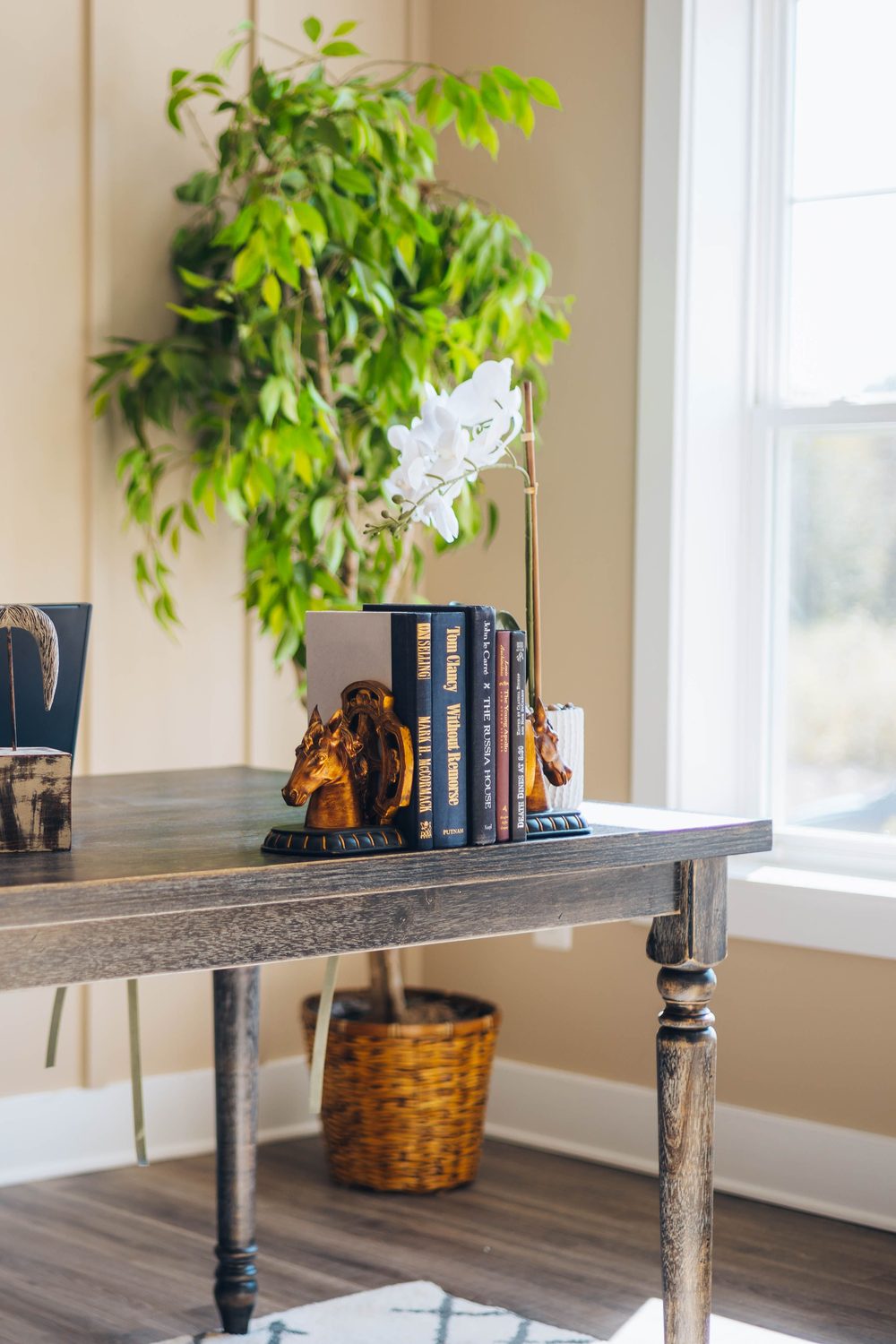
Layer your lighting in three tiers:
- Task light (the workhorse): A swing-arm lamp in black iron or aged brass, such as the Pottery Barn Pivot task lamp ($150) or a budget pick like the Rejuvenation-style lamps on Amazon at $40 to $70. Use a bulb rated 800 lumens at 3000K to 3500K, which is warm white but bright enough.
- Ambient light (the room): Keep your existing lamps and fireplace glow. Add dimmers ($25 each for Lutron Caseta plug-in dimmers) so you can raise brightness for work and lower it at 6 p.m.
- Accent light (the vibe): A picture light over a shelf or a string of warm 2200K Edison bulbs gives the rustic feel without being your primary source.
Put the task lamp on the opposite side of your writing hand. Right-handed? Place it to the left, so your hand does not cast a shadow on the page or keyboard. But what if you use only a laptop? The same rule applies, because glare on a glossy screen is the main culprit. Angle the lamp so the beam hits the desk, not the screen.
Success check: no visible shadows on your keyboard, no glare reflection on the monitor, and you can read a printed page without leaning in.
Hiding Tech and Cables So It Still Looks Like a Rustic Living Room
Nothing breaks the cabin-in-the-woods spell like a tangle of white cables. The fix costs about $60 to $120 and takes under two hours.
The cable-hiding sequence
- Unplug everything and photograph the mess. This tells you what you actually have. Expect 6 to 10 cables.
- Mount a power strip under the desk. Use the strip’s built-in screw holes and 3 wood screws (1 inch). Success looks like zero cords on the floor.
- Bundle with fabric sleeves. A 6-foot black cable sleeve ($12 on Amazon) wraps 3 to 5 cables into one clean line. Velcro ties ($8 for 50) work for shorter runs.
- Route along the desk edge or leg. Use adhesive clips ($10 for 40) and run the bundle down the back leg to the outlet. But what if your desk is a thick slab with no back panel? A J-channel cable raceway painted to match the wood hides the run for about $15.
- Disguise the router and printer. Place them in a vented wooden crate, a leather trunk with a hole drilled for the cord, or a closed cabinet with the back removed for airflow.
Other tech-hiding tricks that fit the aesthetic:
- Wood monitor riser: A walnut or oak riser ($30 to $60) hides cables and puts the screen top at eye level.
- Wireless peripherals: A wireless keyboard and mouse (Logitech MX Keys and MX Master, about $200 combined) eliminate two cables.
- Black or bronze hardware: Swap white USB hubs for black ones. Matte black blends into wood far better.
Leave 2 inches of slack on every cable so you can move equipment without yanking plugs.
Storage and Organization With Trunks, Baskets, and Blanket Ladders
Paper clutter and charger spaghetti will destroy a rustic living room faster than any décor mistake. The solution is closed storage that looks like it belongs in a lodge.
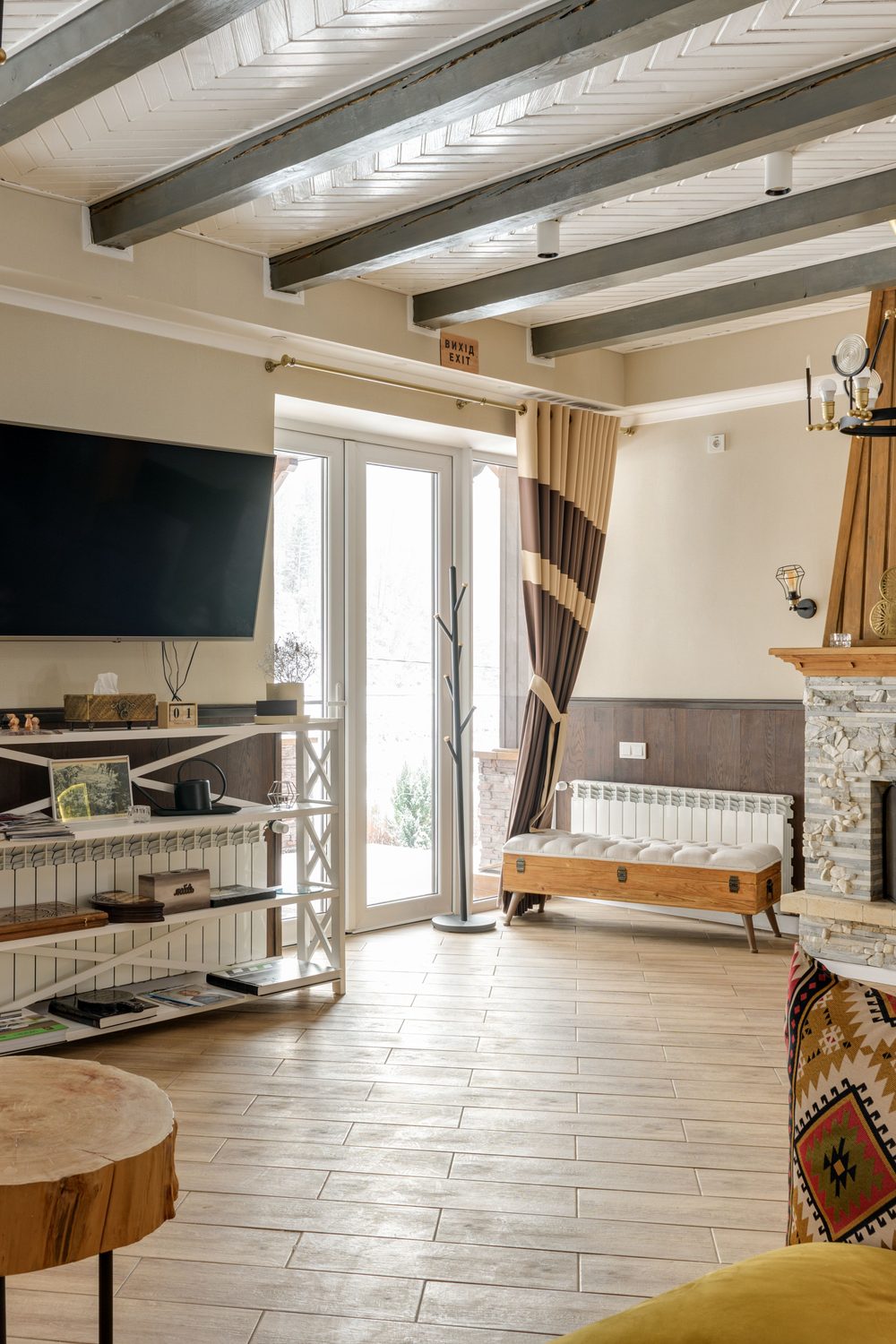
Match storage to the item:
- Files and documents: A 2-drawer wood filing cabinet in stained pine or oak runs $120 to $280 (Sauder and Prepac both make rustic-finish options). It slides under a desk or doubles as a side table.
- Chargers and small gear: A lidded wicker or seagrass basket (about 14 inches wide, $25 to $45) sits on a shelf and hides 5 to 8 chargers.
- Laptop and notebooks at day’s end: A leather-and-wood magazine rack or an old wooden crate on the floor keeps them handy but tidy.
- Bulky supplies: A storage trunk at the foot of the sofa holds reams of paper, a printer, and even a monitor stand, and works as extra seating.
Use vertical space. A set of 3 floating shelves at 8 inches deep and 36 inches wide, mounted into studs, costs $60 to $150 and holds 25 to 30 pounds per shelf. Space the shelves 12 inches apart so books and boxes fit.
Adopt the 5-minute reset rule: at the end of every workday, everything returns to a closed container within 5 minutes. But what if you work from the sofa sometimes? Keep a lap desk (like the LapGear Home Office, $40) in a basket by the couch so the sofa never becomes a permanent drop zone.
The goal: when your workday ends, the room should read as a living room, not an office.
Textiles, Rugs, and Acoustics: The Underrated Comfort Layer
Hard wood floors, stone fireplaces, and high ceilings look great and sound terrible on video calls. Echo makes you sound distant and tires everyone on the other end.
The fix is soft surfaces, and rustic style already loves them. Add these in order of impact:
- A large wool or jute rug. Aim for at least 8 by 10 feet in a living room, with the desk chair sitting fully on it. A 100 percent wool rug (Ruggable offers washable options from $200, and Pottery Barn runs $500 to $1,400) absorbs more sound than synthetic. Add a 1/4-inch felt pad underneath for another 30 percent noise damping.
- Heavy curtains. Linen-cotton blends with a thermal lining on a wrought iron rod block both sound and drafts. Expect $60 to $150 per panel.
- Upholstered pieces. A leather sofa and chunky knit throws soak up echo. Add 2 to 3 throw pillows on any hard bench or chair.
- Wall-hung textiles. A woven tapestry or a quilted wall hanging on the wall behind you cuts reflections. Hang it directly behind your video call position.
Test it: stand in your work spot and clap once. If you hear a metallic ring or a quick echo, add more soft material. A good room gives a short, dull “thud.”
Color matters too. Stick to a palette of 3 to 4 colors: warm browns, forest green, cream, and one accent such as rust or deep red. This keeps the room cohesive even with a desk in the corner.
7 Mistakes That Make a Rustic Living Room Workspace Fail (and the Fixes)
After seeing dozens of these setups, the same errors repeat. Here are the big ones with exact fixes.
- Mistake: Buying a gorgeous desk at the wrong height. A 31-inch table forces your shoulders up. Fix: Measure first. Sit with elbows at 90 degrees, measure the floor-to-elbow distance, and shop for that number (usually 28 to 30 inches). If you already own it, add a keyboard tray ($40 to $80).
- Mistake: Relying on ambient lighting. A 40-watt living room lamp gives maybe 100 lux at the desk. Fix: Add a dedicated 800-lumen task lamp.
- Mistake: Using a decorative chair for full workdays. Fix: Invest $350 to $600 in a real ergonomic chair, or at minimum add a lumbar cushion.
- Mistake: Letting cables show. Fix: Use the 5-step cable sequence above for under $60.
- Mistake: Over-rusticating. Too many antlers, barn signs, and mason jars turns the room into a theme restaurant. Fix: Follow the 60-30-10 rule: 60 percent neutral base, 30 percent wood and texture, 10 percent accent decor.
- Mistake: Ignoring the desk finish. Raw wood stains from coffee rings and warps from humidity. Fix: Seal with 2 coats of Minwax Polycrylic or Rubio Monocoat ($40 to $60), sanding lightly with 220-grit between coats.
- Mistake: Placing the desk in the room’s main traffic path. Fix: Keep at least 36 inches of walkway clearance, so nobody brushes your chair.
Catching even three of these early saves you roughly $200 to $500 in returns and replacements.
Objections and “What If” Scenarios Answered Honestly
Before you commit, here are the doubts that come up most often.
“What if I rent and can’t drill into walls?”
Use freestanding bookcases, a leaning shelf, and Command-brand heavy-duty strips (they hold up to 16 pounds per set of 4 strips) for lightweight items. A standalone desk with a hutch gives you wall-like storage without a single hole. Choose furniture 30 inches deep or less to avoid crowding the room.
“What if my living room is under 200 square feet?”
A wall-mounted fold-down desk (around 36 by 20 inches) or a narrow console table used as a desk (12 to 16 inches deep with a laptop only) fits tight rooms. Pair it with a slim stool that slides under. Total floor impact: under 6 square feet when folded.
“What if my partner or kids use the room at the same time?”
Add a bookcase or a folding screen as a visual divider. A 5-foot-tall shelving unit between the sofa and desk blocks sightlines and trims noise. Noise-canceling headphones such as the Sony WH-1000XM5 ($330, often discounted to $280) handle the rest.
“What if rustic feels too heavy for me?”
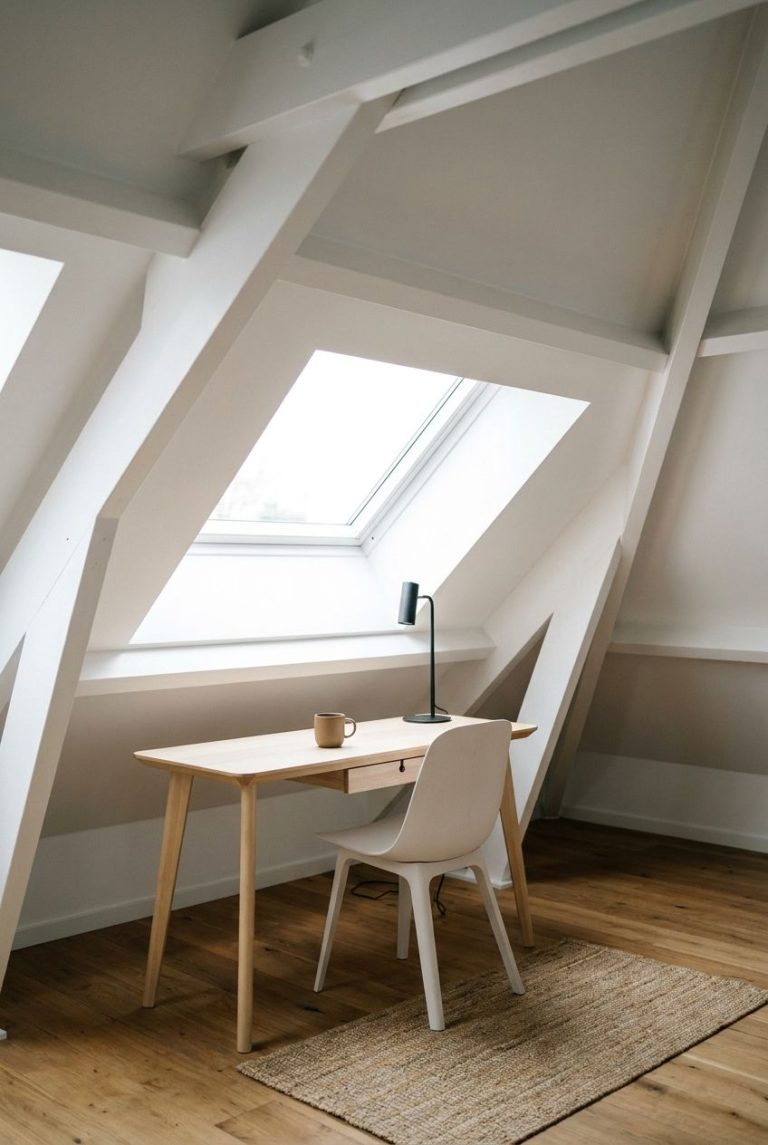
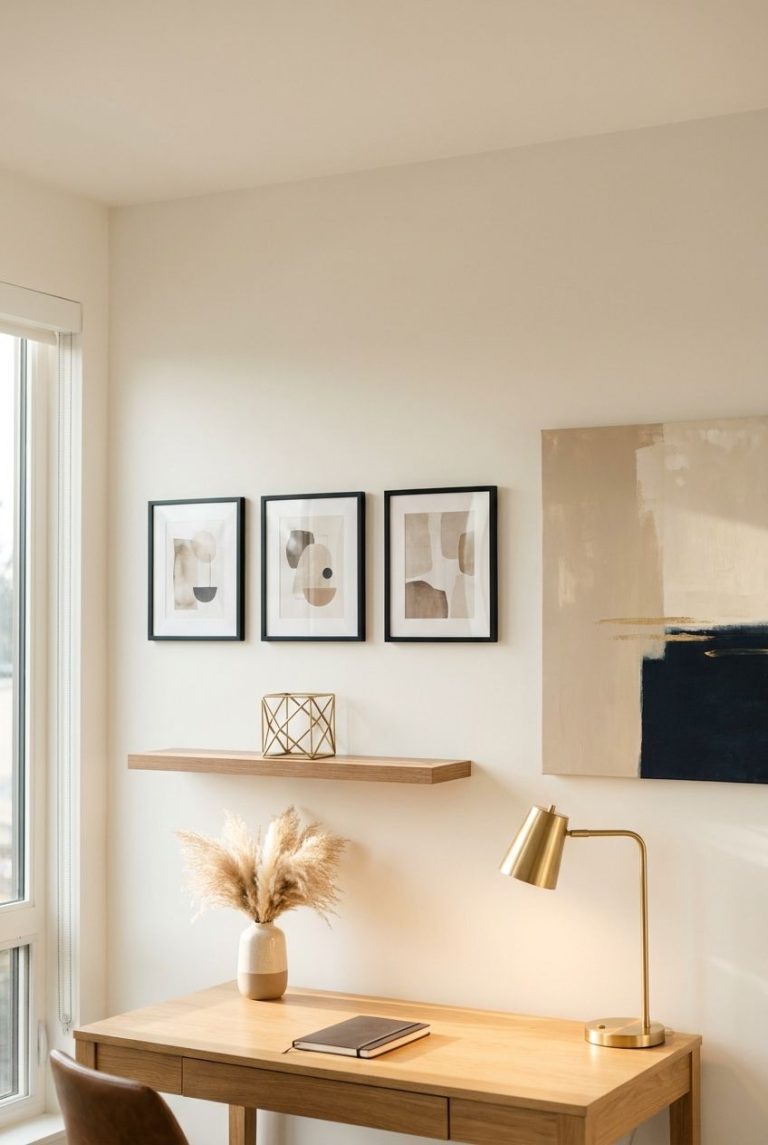
Go lighter with whitewashed or pale oak wood, cream linen, and fewer dark iron accents. This is sometimes called “modern rustic” or “Scandi-cabin,” and it keeps the warmth with less visual weight.
“What if the whole thing costs too much?”
A full budget build is possible for about $650: DIY butcher-block desk ($210), used ergonomic chair ($150), task lamp ($45), cable kit ($40), rug ($120), basket and shelf ($85). Splurge later on the chair and desk.
Your Next Move: Do the 30-Minute Spot Test This Weekend
Do not buy anything yet. Grab a tape measure, your laptop, and a notepad, and run the 4-point spot test from earlier on your top two candidate corners. Write down the footprint, light direction, Wi-Fi speed, and outlet count for each.
Then set a hard budget number, pick one of the three desk paths in the table above, and order only the desk and chair first. Live with them for 7 days before adding lamps, rugs, and storage. You will quickly learn what your workspace actually needs, and your rustic living room will end up feeling both warm and genuinely productive.